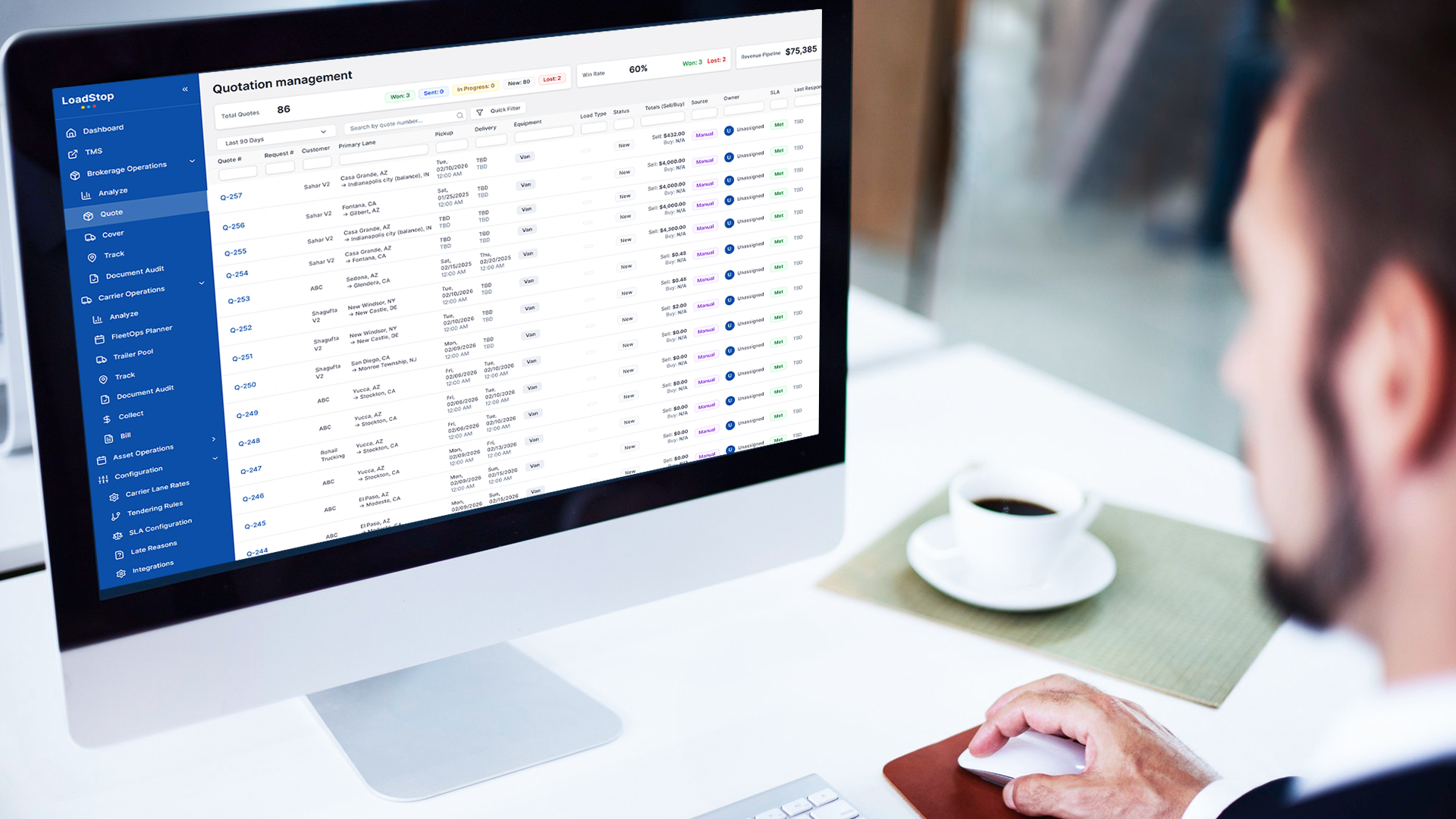
Right now, while your team is manually pulling rates from three different spreadsheets to build a quote, a shipper somewhere is already getting an answer from your competitor.
For most brokerages, the gap between first and second place is not better pricing. It is faster inbound freight quote automation.
But speed without discipline is just a faster way to underquote. The brokerages consistently winning new shipper business are not just responding faster. They are responding faster and protecting their margins on every single load. This post breaks down exactly how they do both.
Why slow quoting is costing freight brokers more than they realize
Most operations managers know slow quoting hurts win rates. Fewer know exactly how much it costs.
According to research on freight quote speed and automation, 60% of freight brokers say they lose loads because they cannot quote fast enough. The freight industry spends over $23 billion annually on quoting and bidding activities, yet 70% of those quotes fail because responses arrive too late or contain errors.
A mid-market freight brokerage handling 50 customer freight quote requests per day that is slow on half of them can lose over $2.7 million in annual gross margin from that single inefficiency alone. That is not a technology problem. That is a revenue leak hiding inside a manual freight broker quoting workflow.
The speed gap between average and top brokers is striking. Industry data from GoFreight shows that the average freight forwarder response time runs 90 hours. Top-performing operations respond in under 30 minutes. Responding within 10 minutes makes a close rate 5 to 8 times higher than waiting 24 hours.
And the pressure is only increasing. According to Global Trade Magazine’s analysis of freight brokerage speed, enterprise shippers are telling their broker partners directly: respond in seconds or lose the freight. Brokers respond to less than 10% of available freight quote requests in shipper TMS portals.
100% of freight brokerages lose loads because they cannot quote fast enough. The broker who responds first wins the chance to build the relationship. The broker who responds hours later often does not get a response at all.
Why manual freight quoting breaks down at scale: the 5 bottlenecks
Manual quoting does not fail because people are slow. It fails because the process was designed for a world where shippers gave you time to think. That world no longer exists. Every inbound RFQ that sits in a queue for more than a few minutes is a quote turnaround time problem, and shippers notice.
Here are the five places where manual quoting processes reliably fall apart as volume grows.
The 5 Manual Quoting Bottlenecks
Rate hunting across scattered spreadsheets and carrier portals
5 – 15 min per quoteManual data entry of shipment details from emails and PDFs
5 – 10 min per requestMargin calculation done by hand for every single load
3 – 8 min per loadAccessorial and fuel surcharge formulas applied inconsistently
2 – 5 min per quoteQuote delivery requiring manual email composition and send
3 – 6 min per response1. Rate data scattered across too many places
Contract rates in one spreadsheet. Spot quotes from a carrier email. Fuel surcharges buried in a PDF. A broker who needs to build a freight rate quote for an unfamiliar lane has to pull from five different sources before they can put a number together. Every search takes time. Every manual lookup is a step between you and a response.
Top-performing operations solve this by centralizing all rate data into a single freight brokerage software platform, where any broker on the team can access carrier contracts, spot market pricing benchmarks, and accessorial schedules from one screen in seconds.
2. Manual data extraction from inbound requests
A shipper sends an email with shipment details scattered across three paragraphs. Someone on your team reads it, finds the relevant details, and types them into your TMS or freight quote software. That step takes 5 to 10 minutes per request. At 40 shipper quote requests per day, that is over three hours of manual data entry before a single rate has been calculated.
Knowing how to automate inbound RFQ emails is the single fastest way to cut this time to zero. When a quote request comes in, the system reads the email or attached PDF, extracts all relevant shipment data, and populates the quoting workflow automatically. Your team reviews and confirms instead of typing from scratch.
3. Margin calculations done by memory or by hand
Ask five brokers on the same team how they calculate their margin and you will get five different answers. Some use a standard percentage. Some adjust by lane. Some factor in shipper payment history. Without a codified target margin in the system, every quote is a manual calculation, and inconsistent ones create margin leakage that compounds across thousands of loads per year.
This is where quoting fast and losing margin happen simultaneously. A broker under volume pressure makes a quick margin estimate to respond faster, underprices the load, and does not realize the damage until the month-end P&L. Pricing desk automation is the fix.
4. Accessorial and fuel surcharge errors
A quote that leaves out a liftgate fee, a residential delivery charge, or an updated fuel surcharge is a quote that costs you money the moment it gets accepted. Manual quoting relies on the broker remembering which accessorial charges apply and looking up the current surcharge rate. Both of those steps fail under volume pressure.
5. Quote delivery still requires manual effort
Even after the rate is built, many brokers still compose the reply email manually, format the quote, and send it. In a process measured in minutes, that final step adds unnecessary time and creates one more point where requests fall through the cracks.
What inbound freight quote automation looks like end to end
Automated freight quoting is not a black box that guesses at rates. It is the broker’s own pricing logic, carrier data, and margin rules built into a system that executes them on every inbound request automatically. Here is the end-to-end broker quote automation workflow that top brokerages run today.
The Instant Quote Workflow
Total cycle: Under 60 seconds
Step 01
Inbound request received
Email, portal, TMS, phone, or web form. Everything feeds one queue.
Step 02
AI extracts shipment data
Origin, destination, weight, equipment, dates. Automatically, no manual entry.
Step 03
Rate database queried
Carrier contracts, spot rates, and load board APIs checked simultaneously.
Step 04
Margin and accessorial logic applied
Lane margins, surcharges, and shipper rules. No human calculation required.
Step 05
Quote generated and delivered
Formatted, accurate freight rate quote sent to the shipper in seconds.
Step 06
Win/loss tracked
Every outcome logged, feeding lane intelligence and rate benchmarking.
- Request comes in: Email, shipper TMS portal, API, phone call, or web form. Everything feeds the same freight quote management queue.
- AI extracts shipment data: The system reads the inbound request and pulls origin, destination, weight, freight class, equipment type, pickup window, and any special requirements. No manual entry.
- Rate database queried: The system checks your centralized rate database, carrier contracts, real-time spot freight rates from integrated load board APIs, and historical lane data simultaneously.
- Margin and accessorial logic applied: Your codified pricing rules run automatically. Lane-specific target margins, accessorial charges, fuel surcharges, and any shipper-specific rules apply without human calculation. Margin protection is built into every quote, not bolted on after.
- Quote generated and delivered: A formatted, accurate freight rate quote goes to the shipper in seconds. Your brand, your rate, your margin.
- Win/loss tracked: Every outcome is logged, feeding your rate benchmarking data and improving the quote hit rate of your next response on the same lane. This is the beginning of your quote-to-cash intelligence loop.
The entire cycle takes under 60 seconds in a well-automated operation. Your team is not removed from the process. They are freed from the parts that did not require human judgment in the first place.
How to quote fast without losing margin: the part most brokers miss
Speed and margin are not opposites. But they can pull in different directions when quoting is done manually under volume pressure. Here is how the best freight brokerages protect their margins while running faster freight RFQ automation than their competitors.
Set a minimum margin floor in your system, not in someone’s head
A target margin that exists only in a dispatcher’s memory is a margin that disappears whenever that dispatcher is busy, stressed, or distracted. The moment quoting volume picks up, the mental shortcuts kick in and margins compress.
Top brokerages encode their minimum margin floors directly into their freight pricing automation. Every quote generated by the system checks the proposed rate against the floor before it goes out. A quote that would undercut your minimum gets flagged for review instead of sent. A quote above the floor goes automatically. This keeps your team fast on the easy loads and attentive on the edge cases.
Use lane history and rate benchmarking to price with confidence
One of the biggest sources of underquoting is uncertainty. When a broker is not sure what a lane should cost, they tend to price low rather than risk losing the load. The result is a freight rate that wins but hurts.
Rate benchmarking against your own historical lane data solves this. When your freight quote software surfaces what you charged on similar moves over the last 90 days, what you won, and what you lost, your broker prices with evidence instead of instinct. The quote hit rate on lanes you already know improves, and margin on those lanes stabilizes.
For brokers who want to understand how automated matching connects directly to better pricing discipline, read how LoadStop’s automated freight matching for brokers eliminates the guesswork from carrier selection and rate validation.
Track tender conversion, not just quote volume
A brokerage quoting 200 loads per day with a 12% tender conversion rate is underperforming one quoting 80 loads per day with a 35% rate. Volume without conversion is just effort without results.
Tender conversion, the percentage of quotes that turn into booked loads, is the clearest signal of whether your freight rate management is working. If your conversion rate is low, one of three things is happening: your rates are too high, your response time is too slow, or both. Either way, your freight quote software should be surfacing this number by lane, by shipper, and by time period so you can act on it.
Automate billing after the quote converts to protect the margin you earned
Winning the load is only half of margin protection. The other half is making sure the revenue you quoted actually gets invoiced and collected correctly. Missed accessorial charges on delivery, unbilled detention, and invoice errors eat directly into the margin your quoting process just protected.
Read how automating billing, PODs, and driver settlements completes the quote-to-cash cycle so the margin you build into your freight quote is the margin that actually hits your P&L.
The 5 components every fast freight quoting operation has in place
Getting to instant quoting with margin protection does not require rebuilding your entire operation. It requires putting five specific components in place and connecting them.
1. A centralized rate database
This is the foundation. Every carrier contract, spot rate, tariff, fuel surcharge schedule, and accessorial fee lives in one searchable system. No folders. No emailed Excel files. No version conflicts.
Operations that maintain centralized rate databases report 30% better margin consistency compared to those relying on fragmented rate sources, because every quote applies the same current data, not whatever the broker last remembered or saved.
2. AI-powered data extraction from inbound RFQs
Inbound freight requests arrive in every format: emails with details buried in paragraphs, PDF rate confirmations, structured EDI files, TMS portal tenders, and web forms. AI quote generation reads all of them.
It identifies shipment details regardless of format and populates your quoting workflow without requiring a human to manually copy data across. This is the core of freight rate automation: the work that used to take 5 to 10 minutes per request now takes seconds, and it happens before your broker even looks at the screen.
3. Codified margin rules and pricing logic
One of the most valuable things a brokerage can do is write down how it prices freight and put those rules into the system. Lane-specific target margins. Minimum margin floors. Shipper-specific rules. Accessorial logic by location and freight type. Fuel surcharge formulas tied to current index data.
When those rules live in a document on someone’s desk, they get applied inconsistently. When they live in the freight brokerage software, they apply automatically to every single quote, 24 hours a day, even when your best broker is unavailable.
4. Real-time market rate integration
Contract rates cover your regular lanes. For spot quote requests and unfamiliar routes, you need live market data. The best quoting operations integrate directly with DAT, Truckstop, and carrier API feeds so real-time spot freight rates are available inside the same quoting workflow, without the broker opening a separate tool.
This removes the most time-consuming step in the manual quoting process. The information comes to the broker instead of the broker going to find it.
5. Multi-channel inbound RFQ intake
Shippers send requests through every channel: email, TMS portals, load boards, phone calls, API connections, and web forms. A fast freight quote management system catches all of them in one place.
When they all flow into a single quoting queue, every request gets a response, and your team works from one prioritized list instead of five disconnected ones. This is the best way to manage inbound freight RFQs at scale without hiring more people.
How AI freight quoting takes speed and margin protection further
Automation handles the repetitive steps. AI freight quoting handles the intelligent ones.
There is a meaningful difference between a quoting system that runs your rules and one that learns from your outcomes. Rule-based automation executes what you tell it. AI quote generation gets smarter over time, identifying patterns in what wins, what loses, and where your pricing needs adjustment before you notice the problem.
Here is what AI adds to a freight pricing automation operation that plain automation cannot:
Lane intelligence
AI tracks quote hit rate by lane, by shipper, and by rate range. Over time it tells you not just what the market rate is, but what rate you need to quote to win this specific shipper on this specific lane.
Demand forecasting
AI identifies capacity tightening trends before they hit your cost structure. If a lane is about to get more expensive to cover, an AI-powered system flags it so you can adjust rates proactively instead of quoting yesterday's margin on tomorrow's costs.
Document reading at scale
Rate confirmations, PDFs, emails, and TMS exports. AI reads them all and extracts structured data without manual processing. At C.H. Robinson, AI systems now handle over 2,000 quote requests daily in under 30 seconds, according to Tank Transport's analysis of AI in freight brokerage.
24/7 response coverage
Shippers send spot quote requests at midnight, on weekends, and during holidays. An AI-powered system responds accurately and competitively around the clock, applying the same intelligence your best broker would use at 3 PM on a Tuesday.
LoadStop’s AI-powered freight broker TMS applies this intelligence across the full quoting and dispatch workflow. When a request comes in, the system extracts shipment data, queries the rate database, applies margin rules, and generates an instant freight quote without requiring a dispatcher to start from scratch on each request. The result is a 50% faster quote-to-dispatch cycle with the accuracy and margin consistency that comes from freight pricing automation applied systematically.
For a deeper look at how automated carrier matching connects to a faster, more disciplined quoting operation, read our guide on automated freight matching and booking for brokers and how it eliminates the manual carrier search that slows the quote-to-dispatch workflow.
Average quote turnaround time
Top-performing operations respond to inbound requests in under 5 minutes. The industry average still sits between 45 minutes and several hours. If your team does not know their current average, that is the first number to establish.
Quote hit rate
Industry win rates vary from 2% to 20% depending on the brokerage, lane, and shipper. A brokerage that reduces response time from 2 hours to under 5 minutes typically sees a 9 to 11 percentage point improvement in quote hit rate on the same lead volume. One AI deployment tracked by Debales AI showed a jump from 18% to 27% after cutting response time to under 60 seconds.
Quote volume per rep per day
A manual quoting process caps most reps at 15 to 25 quotes per day. An automated system with AI data extraction can push that to 60 to 100 without increasing errors or margin inconsistency.
Margin variance per load
How much does your actual margin per load deviate from your target margin? Manual processes typically show 15 to 20% variance. Automated quoting with codified margin rules brings that number below 5%.
Tender conversion rate
What percentage of your quotes turn into booked loads? A strong tender conversion rate for repeat shippers is 30% or above. Brokerages using rate benchmarking and AI Quoting consistently outperform those using manual pricing on this metric.
After-hours coverage rate
What percentage of requests received outside business hours get a response before the next business day? For most manually-operated brokerages, this number is close to zero. For automated operations, it should be close to 100%.
Freight quoting benchmarks worth tracking in your operation
You cannot improve what you do not measure. These are the benchmarks top freight brokerages and 3PLs use to evaluate their quoting performance.
Brokerages using modern TMS tools see a 2 to 3x increase in loads covered per employee. The math is simple: double your coverage speed and you either handle double the volume with the same team, or you cut your team cost in half.
| Metric | Manual | Automated |
|---|---|---|
| Avg quote turnaround time | 45 min – 3 hours | Under 60 seconds |
| Quote hit rate | 15 – 20% | 24 – 30% |
| Quotes per rep per day | 15 – 25 | 60 – 100 |
| Margin variance per load | 15 – 20% | Under 5% |
| Tender conversion rate | 12 – 18% | 28 – 35% |
| After-hours coverage | Near 0% | Near 100% |
| The gap between these columns is a process gap, not a people gap. | ||
FAQs
Share
Trending Articles
Get a daily dose of industry insights, tips, and updates to keep you informed and inspired.