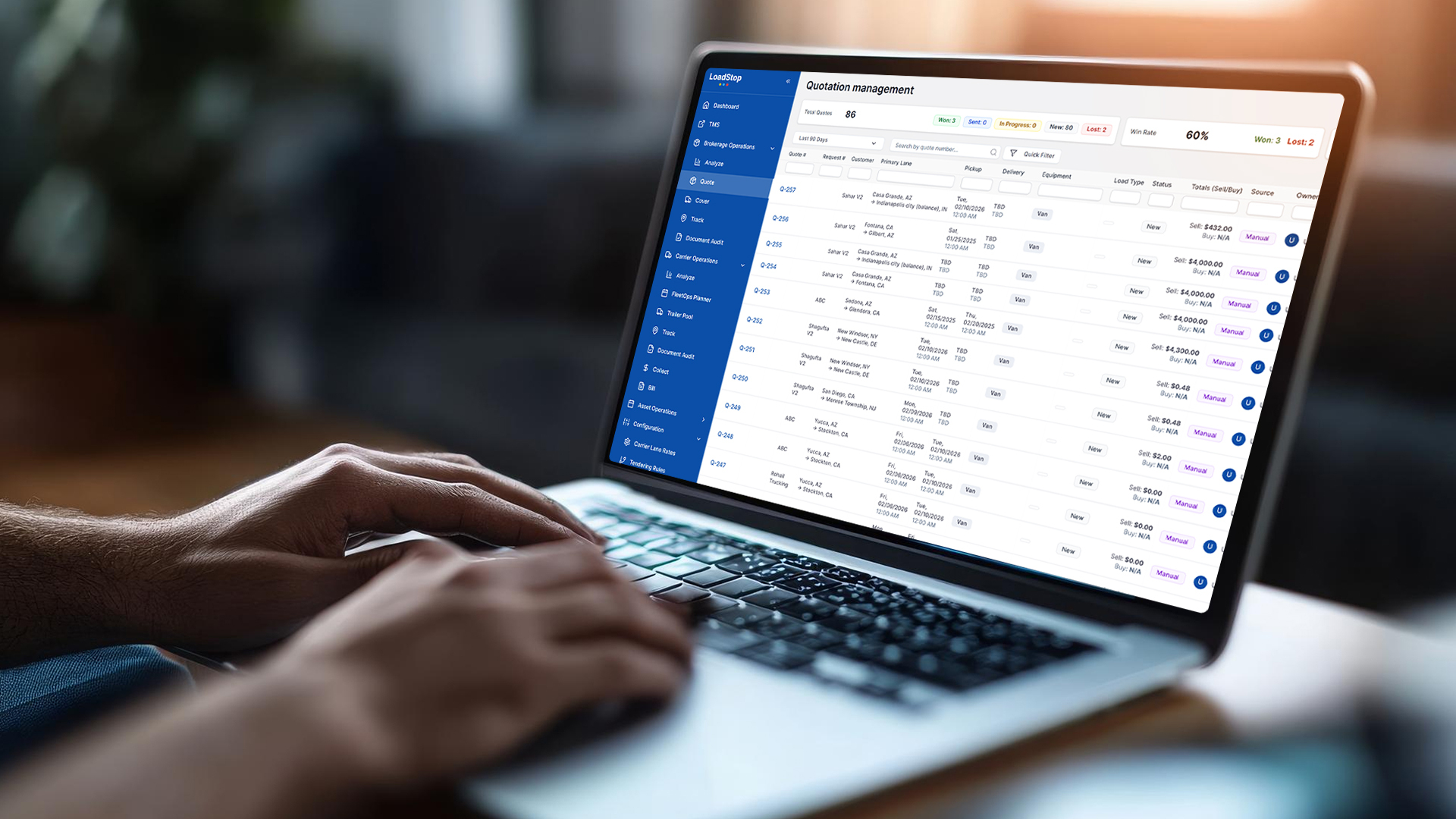
The carrier picked up on time. Delivery went smooth. The shipper is happy. But your billing team is chasing a POD, manually re-entering data into an invoice, and hoping the shipper’s AP team does not come back with a dispute in two weeks.
The freight moved in hours. The cash takes 40 days.
Most brokers treat slow billing as a back-office inconvenience. It is not. It is a margin problem hiding in plain sight. Every day between delivery and cash in the bank is a day your business is quietly financing someone else’s operations. This blog identifies exactly where the quote-to-cash process in freight bleeds time and money, and how freight broker billing automation seals each leak permanently.
What Is the Quote-to-Cash Process in Freight?
The quote-to-cash cycle starts the moment you price a load and ends the moment payment clears. For freight brokers, it runs through seven distinct handoffs:
- Quote issued to the shipper
- Rate confirmation sent to and signed by the carrier
- Load dispatched and tracked in transit
- POD and BOL collected at delivery
- Invoice generated and sent to the shipper
- Carrier settlement processed and paid out
- Payment collected from the shipper, load closed
The problem is not the number of steps. It is that in most brokerages, each step runs in a separate tool, owned by a different person, with no automated handoff between them. A load can deliver on Monday and still not have an invoice out by Friday.
If you’re still relying on traditional load boards, it’s worth understanding how smarter load boards are changing how loads get discovered and covered.
What Load Details Matter Most to Carriers?
This is a question every broker should be able to answer cold. Carriers make bid decisions in seconds. Your load listing needs to give them everything they need before they move on to the next one.
The Load Information Checklist
The Quote-to-Cash Workflow: Where Bottlenecks Hit Hardest
| Step | Action | Risk Without Automation |
|---|---|---|
| 1 |
Quote issued to shipper
|
Slow manual pricing loses deals to faster brokers |
| 2 |
Rate confirmation to carrier
|
Email errors force re-sends, delay booking confirmation |
| 3 |
Load dispatched and tracked
|
No visibility between check-calls creates SLA gaps |
| 4 |
POD and BOL collected
|
Carrier chasing adds 2 to 4 days before billing can start |
| 5 |
Invoice generated and sent
|
Manual data entry errors trigger disputes and short pays |
| 6 |
Carrier settlement processed
|
Unreconciled accessorials create underpayments and trust damage |
| 7 |
Payment collected from shipper
|
Disputes or submission errors extend DSO well past net terms |
Why Disconnected Systems Are the Real Problem
The individual tasks in the quote-to-cash process are not complicated. Quoting a lane, sending a confirmation, collecting a POD, none of these require special skill. The problem is that each task lives in a different place.
Your quoting tool does not talk to your TMS. Your TMS does not automatically request the POD at delivery. Your POD does not trigger the invoice. Your invoice does not sync to your accounting system without someone copying data manually. That disconnection is where time and accuracy go to die.
According to research on delayed payments in trucking, manual re-entry between disconnected systems is one of the leading causes of billing delays and invoice inaccuracies across freight operations. The tools exist. The data exists. The connection between them does not.
When a load closes and the next person in the chain has to manually pull data from the previous step, you have introduced a delay, a potential error, and a dependency on someone being available at the right moment. Multiply that across hundreds of loads per month and you get a DSO of 35 to 51 days on freight that delivers in one.
The Delivery-to-Invoice Gap: What It Actually Costs You
Most brokers underestimate this gap because they track DSO as a number, not as a cash figure. The freight payment process runs in two directions simultaneously: brokers pay carriers on short timelines while collecting from shippers on net 30 to 45 terms. When the invoice goes out five days late, your effective payment terms become net 35 to 50 without anyone agreeing to that. It compounds across every load, every month. A brokerage moving 500 loads at a $2,500 average invoice with a five-day invoicing lag is floating $312,500 in unbilled receivables at any given time.
Where Revenue Leakage Hides Beyond Late Invoicing
Slow cash collection is the visible problem. What happens silently is worse.
- Accessorial charges that never get invoiced. Detention pay, liftgate fees, layover charges, and fuel surcharges get verbally agreed at the time of service and forgotten by the time billing runs the load. There is no line item, no record, no recovery. This is money earned and not collected.
- Shipper invoice submission windows you miss. Many enterprise shippers have contractual invoice submission deadlines of 30 to 90 days from delivery. Miss it and the invoice is rejected entirely, not delayed. The load is a loss regardless of what the shipper owes.
- Short pays caused by BOL discrepancies. When the invoice references a BOL number that does not match the shipper’s PO system, their AP team does not dispute it, they just pay what they can match and hold the rest. The broker has to identify the discrepancy, correct it, and resubmit. That process adds weeks.
- Settlement underpayments that go unnoticed. When carrier invoices are not reconciled line-by-line against rate confirmations, overpayments and underpayments both happen. Overpayments hurt margin immediately. Underpayments create carrier disputes that damage retention.
For a full picture of how revenue leakage compounds across the freight lifecycle, see our article on reducing costs with AI in freight.
How LoadStop Billing Automation Closes Each Gap
Automation does not just speed up existing steps. It removes the handoffs between them entirely.
Quote-to-Confirmation in One System
When quoting and booking live in the same platform, the rate confirmation generates from the live load record, not a copied email template. The carrier receives accurate details the first time: correct lane, rate, pickup window, and equipment requirement. More importantly, the rate that was quoted to the shipper and the rate confirmed with the carrier are the same record, which means when the invoice generates later, it cannot mismatch because it pulls from the same source.
Shipper decisions in spot freight often go to the first broker to respond with a clean, priced offer. Freight quote automation cuts response time from hours to minutes by pulling current market rates alongside your historical lane margin, so your team sends a confident number fast instead of researching one slowly. Real-time rate benchmarking from sources like DAT RateView gives brokers the market context to price aggressively without guessing.
POD Automation That Starts at Delivery, Not After
The most common approach to POD collection is reactive: load delivers, someone notices, someone sends an email, someone follows up three days later. Automated POD collection flips this entirely. At the moment of delivery confirmation, the system sends an automatic document request to the carrier. When the proof of delivery comes back, it attaches to the load record and triggers the invoice workflow without anyone initiating it.
This single change: making POD collection proactive rather than reactive; is responsible for most of the DSO improvement brokers see after implementing freight billing automation. See our full breakdown of automating billing, PODs, and driver settlements for a detailed walkthrough of how it works operationally.
Accessorial Capture That Happens in Real Time
The only reliable way to invoice accessorial charges is to capture them at the moment they occur. When detention starts, the system logs the timestamp. When a liftgate gets requested, it creates a charge line. When a layover happens, it records the duration. None of this depends on someone remembering to add it to the invoice later, because the invoice builds itself from the logged events. Accessorials that used to fall off invoices regularly stop disappearing.
Invoice Generation as an Output, Not a Task
When POD receipt automatically triggers invoice creation from verified load data, billing stops being a task your team performs and starts being an output the system produces. Your billing team’s job shifts from data entry and document chasing to review and approval. Invoice cycle time drops from five or six days to same-day. For more on why brokers struggle to measure load-level profitability without connected billing data, see our post on why fleets cannot measure profits per load efficiently.
Carrier Settlement That Does Not Create Its Own Problems
Manual carrier settlement creates a specific problem: by the time someone reconciles what was agreed in the rate confirmation against what the carrier invoiced, the load is weeks old and the details are blurry.
Automated reconciliation runs the match immediately, flags any discrepancy, and queues it for review before payment goes out. Carriers get paid correctly the first time. Disputes that used to surface as angry calls three weeks after delivery get caught and resolved before payment runs.
Manual vs. Automated: The Billing Timeline Side by Side
| Step | Manual Brokerage | Automated Brokerage |
|---|---|---|
| Quote turnaround | 2 to 4 hours | Under 5 minutes |
| Rate confirmation sent | Same or next day | Instant from load record |
| POD collected | Day 2 to 4 post-delivery | Same day, auto-requested |
| Invoice generated | Day 4 to 6 post-delivery | Same day as POD |
| Invoice sent to shipper | Day 5 to 7 | Day 1 after delivery |
| Carrier settlement | Day 7 to 14 | Day 2 to 3 |
| Effective DSO | 35 to 51 days | 21 to 37 days |
What Causes Invoice Disputes and How to Stop Them Before They Start
Disputes do not appear randomly. They come from four structural gaps that automation closes by design.
- Rate confirmation and invoice built from different data. When your team quotes in one tool and invoices in another, the numbers sometimes diverge by rounding errors, outdated rates, or simple typos. Shippers reconcile invoices against their own records and flag any discrepancy. Even a $15 difference holds up a $3,000 invoice.
- Detention without a documented timestamp. Shippers do not dispute detention because they are cheap. They dispute it because the broker cannot prove when the driver arrived and departed. A timestamped, system-generated detention record is the only documentation that consistently wins these disputes.
- Wrong PO or reference number on the invoice. Large shipper AP teams use automated matching to route invoices to the right department. An incorrect reference number routes the invoice to a manual review queue where it sits until someone investigates. Generating invoices directly from the shipment record eliminates this because the shipper’s reference data is captured at booking, not retyped at billing.
- Submitting after the shipper’s invoice deadline. This one has no recovery. Same-day invoicing triggered by POD receipt removes the possibility of a late submission because the invoice goes out before anyone has a chance to miss a deadline.
How to Reduce DSO Without a Difficult Conversation
Most DSO reduction advice focuses on chasing shippers. The better approach is eliminating the reasons shippers delay.
Benchmark your current delivery-to-invoice gap. Pull the last 90 days of loads and calculate the average time between delivery confirmation and invoice sent date. Most brokers discover this gap is three to seven days longer than they assumed. That gap, multiplied across load volume, is your DSO problem in concrete numbers.
Identify which shippers generate the most disputes. Not all DSOs are created equal. A single shipper with a complex PO matching system or strict submission requirements can inflate your overall DSO more than the rest of your book combined. Knowing which relationships need different handling lets you prioritize automation where it has the most impact.
Use payment reminders as a cash flow tool, not a collections tactic. Automated reminders at day 15, 25, and 29 of net terms are not aggressive. They are professional. Most delayed payments happen because invoices get buried in AP queues. A reminder with a direct link to the invoice, the POD, and the BOL gives the shipper’s team everything they need to process payment without coming back to you with questions.
Separate your carrier payment timeline from your shipper collection timeline. When carrier settlement runs on a fixed, automated cycle regardless of when the shipper pays, you maintain carrier relationships even during slow collection periods. Quick pay options for carriers reduce the timeline pressure without requiring brokers to front cash indefinitely.
What a Connected Broker TMS Actually Changes
A transportation management system for brokers earns its cost by eliminating the manual handoffs between steps.
Connecting means the system does the work and your team handles exceptions. Here’s what a genuinely connected system handles without human initiation:
- POD and BOL requests fire automatically at delivery
- Invoices generated from verified load data without manual entry
- Accessorial charges log from real-time events, not post-load memory
- Rate confirmations and invoices pull from the same record, so mismatches are structurally impossible
- Carrier settlement matches against confirmed rates and flags discrepancies before payment runs
- Accounting systems receive clean load data via TMS integrations, eliminating double entry entirely
The practical result is that your billing team’s headcount stops scaling with load volume. You can move more freight without adding billing staff because the system handles the volume, not the people.
How LoadStop Delivers This for Freight Brokers
LoadStop is built so that each step in the quote-to-cash process feeds the next one automatically, without your team bridging the gap.
When a load closes in LoadStop, the system requests the POD from the carrier automatically. When the POD comes back, it generates the invoice from the confirmed load data and attaches the documentation.
When the invoice goes out, the carrier settlement process begins reconciling simultaneously. When payment comes in, the load closes and the data pushes to your accounting system without anyone exporting a spreadsheet.
Your billing team sees a queue of invoices ready for review, not a queue of loads waiting to be worked. The difference in how that feels operationally and what it does to your cash flow is immediate.
Explore how AI-powered load building and dispatch connects to the billing workflow, or see our breakdown of load boards for truckers to understand how carrier-side tools feed cleaner data into the settlement process.
Final Thoughts
Low bid volume is a systems problem, not a luck problem.
When carriers skip your loads, they’re responding to friction. Incomplete data. Bad lane economics. Slow payment. Wrong audience. None of that is random. All of it is fixable.
Smart load matching addresses each friction point at the source. It puts complete, accurate loads in front of carriers who are positioned, qualified, and motivated to bid. Automated load matching means you stop starting from scratch on every load and start building a process that improves with every transaction.
That’s how you improve carrier response rate today and carrier retention long term.
LoadStop gives you the bidding automation, carrier onboarding, and freight bidding platform to make that shift. Take a look at the features and find out what your carrier network is actually capable of when it’s working for you.
FAQs
Share
Trending Articles
Get a daily dose of industry insights, tips, and updates to keep you informed and inspired.