

The trucking industry is under immense pressure. Thin margins, volatile demand, and rising costs are persistently pushing small, regional, and legacy carriers and brokers to the brink of bankruptcy.
Nearly 88,000 trucking companies exited the market in 2023 with many following suit in 2024 and 2025 due to record-low freight volumes, high fixed and operating costs, oversupply of small carriers, and stifling legacy debt for enterprise operators.
So is the collapse over? Not yet. While bigger players may be stabilizing, smaller carriers continue exiting. According to industry analysts, exits persist amid cost pressures, though a demand pickup may be coming in late 2025.
And to capitalize on this demand surge, carriers and brokers must implement lean, smart capacity-building measures that protect margins in a highly competitive, high-cost market.
This is exactly where AI load building comes in: to automate, optimize, and completely change the way loads are sourced, built, and dispatched. Just imagine cutting the time to turn a rate confirmation email into a dispatched load from an hour to a few minutes. Or having a virtual assistant scan load boards for truckers 24/7 to find the best loads for your trucks.
In an era where every minute counts and every empty mile hurts the bottom line, AI-driven load management has moved from a nice-to-have tech stack to a must-have necessity to survive against cut-throat competition
This analysis will exactly show you how AI load building works, why it matters for both carriers and brokers, and the real ways LoadStop’s AI Load Build can help you boost your capacity, efficiency, and profitability in a flat market with little margin for error.
The Need for AI in Load Sourcing & Load Building
Carriers and brokers have long relied on phone calls, emails, and load boards to match trucks with freight. Traditionally, finding a good load or truck could mean hours of scrolling through dispatch load boards, sending emails, and making calls – a slow process that burns through manpower.
All that time spent on manual freight matching is time not spent moving goods. Today’s market is unforgiving of such inefficiencies.
Fuel prices, insurance, and labor costs keep climbing while freight rates swing wildly. Many operations are running on razor-thin margins, where any wasted time or empty miles can mean the difference between profit and loss.
AI offers a way out of this efficiency trap. By harnessing algorithms and big data, AI can charge load sourcing and load building in several ways.
First, AI can analyze vast volumes of data faster than any human, identifying patterns in freight availability, rates, and capacity in real time.
Second, AI-driven systems don’t sleep. They can continuously monitor load boards and market conditions 24/7. For example, an AI dispatch assistant can automatically scan for available loads that fit a carrier’s preferences and alert them instantly.
Third, AI can help reduce errors and delays. Manual data entry of load details or driver info is prone to typos and mistakes. A single rate confirmation entry can cause billing headaches or even lost loads.
Most importantly, AI load-building helps carriers and brokers do more with less. In a market where trucking companies are going bankrupt due to high costs and low rates, doing more with the same staff and fleet is vital.
Recently, a McKinsey study found businesses using AI in supply chain operations saw around a 15% reduction in operating costs and 65% improvement in service levels. Dustin Burke of BCG observes, brokers and carriers that lean into AI tools now will likely outpace those that don’t, simply by operating more efficiently and responsively.
What is AI Load Building: Why It Matters?
AI load building is the process of using artificial intelligence to automate the identification, creation, matching, and management of freight loads.
It spans a workflow from the moment a load opportunity is identified to the point a driver is dispatched. Think of all the steps that go into “building” a load in a transportation management system (TMS): entering pickup and delivery details, confirming rates and load info from a rate confirmation (rate con) document, assigning a driver or carrier, planning the route, and eventually dispatching and tracking the load. AI load building automates and enhances each of these steps:

Automated Load Data Ingestion
When a broker receives a load tender or a carrier gets a rate confirmation, AI can instantly extract all the key information – addresses, appointment times, freight details, rates, reference numbers, etc. – and populate it into their system.

Intelligent Load Matching
Freight matching platforms use AI to connect loads with the ideal carriers in real-time. They consider equipment type, location, hours of service, and historical lane preferences. For brokers, AI can suggest which carrier is best suited for them and even automatically send the load offer.

Optimized Load Planning
Beyond just matching one truck to one load, AI load building can optimize more complex scenarios. AI load planning tools can consolidate shipments to maximize trailer utilization and minimize empty miles. This is especially valuable for LTL carriers or any fleet trying to reduce “empty space” on trucks.

Dynamic Route & Dispatch Optimization
Once a load is built, getting it delivered efficiently is the next challenge. An AI system can detect that a truck is about to hit a major traffic jam and proactively re-route it to save time. Or it might reschedule a pickup if it sees a delay that will cause a missed appointment, notifying all parties automatically.
How AI Transforms Load Sourcing: Smarter Load Boards & Matching
Traditionally, brokers post loads on public boards like DAT or Truckstop and call carriers, while carriers troll through endless listings on load boards for truckers hoping to grab a good haul. It’s a labor-intensive process that wastes hundreds of hours every month. AI is turning this manual grind on its head by making load sourcing proactive and automated:

Real-Time Load Board Scanning
Rather than a dispatcher manually refreshing multiple load boards, AI-powered tools can integrate with load board EDIs/APIs and continuously scan for matches. They can factor in a carrier’s preferred lanes, average rate per mile needs, hours of service, and past loads to rank new postings. Over time, the AI gets smarter at picking the loads you’re most likely to want.

Verified & Quality Matches
By verifying and filtering out incomplete or misleading load posts, AI load sourcing spares the frustration of chasing loads that aren’t actually viable. The result is that carriers only see accurate, ready-to-book loads, and brokers get interest from carriers that truly fit the load’s requirements. This improves trust on both sides of a transaction.

Predictive Load Matching
Forecasting algorithms can match freight not just on current data but on predicted market conditions. For example, a broker’s AI might notice that every Thursday afternoon a certain region has empty trucks heading home. The broker could then advise shippers or adjust pricing to route freight into that capacity. This predictive element is something only AI can do at scale by crunching historical patterns and real-time signals.

Recommendations & Automated Offers
Brokers can cover loads faster when the system is doing a mini “email blast” of a new load to the top 5 carriers who’d likely want it. If a match is found, the load can be booked with minimal human involvement. On some platforms, carriers can even configure an “auto-book” setting where the AI will automatically book them on a recommended load if it meets their pre-set price and parameters.
LoadStop’s AI LoadBuild Workflow: Step-by-Step Breakdown
Ingest Data to Build Loads
You drop in any source: rate confirmations, PDFs, emailed docs, spreadsheets, even handwritten notes. Our AI extracts data (stops, pickup/delivery times, line-items, rates, PO numbers, equipment needs).
Parse & Normalize
Smart Validation & Quality Assurance
AI Planning
Our planner uses that clean data to create an optimized load: match equipment type, combine stops where appropriate, sequence pickups/deliveries, and calculate estimated deadhead and drive time to propose optimal truck/trailer/driver assignments.
Unified Integrations Ecosystem
Our integrations ecosystem helps you connect with ELDs, accounting systems, load boards, fuel platforms, ERPs, factoring, and carrier portals, enabling bi-directional data flow, faster decision-making, and quick solutions with a truly unified logistics stack.
Auto-Tendering / Bid & Rate Automation
Once a load is built, the system can auto-tender to preferred carriers, publish to integrated load boards or digital freight marketplaces, or initiate a bid process with carriers, using preconfigured rules (price thresholds, preferred carriers, etc.).
Execution & Tracking
Settlement & Audit
10 Ways LoadStop’s AI Load Build is Helping Carriers and Brokers

Faster Load Creation
By cutting out manual typing, companies have seen 60% less manual effort on load processing tasks.
Why it matters: More loads processed per day and less backlog during peak times.

Error Reduction
Accurate data ingestion, parsing, and verification ensure 80% fewer errors in load data on average.
Why it matters: Fewer load board fall-offs, denied pickups, or billing corrections.

Automated Load Matching
Helps match loads to carriers (or trucks to loads) within seconds, considering dozens of factors (location, capacity, past performance, etc.).
Why it matters: Improves load coverage speed and reduces truck idle time.

Deadhead & Empty Mile Reduction
Carriers using AI-driven planning have cut deadhead by 15–25%.
Why it matters: Every empty mile is fuel burned for zero revenue.

Optimized Routing & Scheduling
Improves on-time delivery rates and fleet efficiency (by roughly 10–20%.
Why it matters: Drivers spend less time in traffic or taking long detours.

Intelligent Driver Assignment
The right driver and equipment for each load, considering hours of service, driver home time requirements, certifications (like Hazmat), and even personal preferences.
Why it matters: The best-fit assignment with safe, on-time delivery and happy drivers.

Streamlined Communication
One AI system cut order delays and miscommunications by 30% by automating updates and follow-ups.
Why it matters: Dispatchers and carrier reps spend less time on the phone repeating the same information.

Faster Quoting & Pricing
AI to answer 2,000+ emailed quote requests daily with instant pricing.
Why it matters: Brokers can turn around customer quotes in seconds, increasing win rates.

Proactive Problem Resolution
Can prevent problems and flag unreliable partners or potential service failures or hurdles ahead of time.
Why it matters: Dispatchers and carrier reps spend less time on the phone repeating the same information.

Accelerated Invoicing & Payment
After delivery, AI can audit documents (PODs, invoices) to cut invoice rejects and fast-track billing rejections by up to 90%.
Why it matters: Brokers can turn around customer quotes in seconds, increasing win rates.
LoadStop’s Industry Wins & Real-World Successes
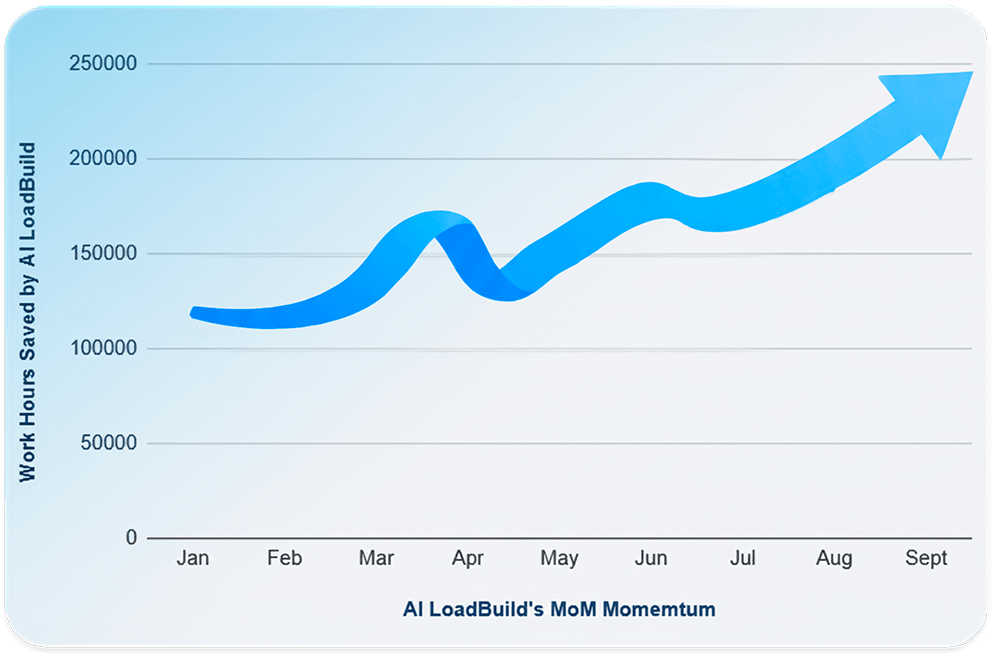
Carriers and brokers using Loadstop’s AI Load Build’s data ingestion and parsing features have saved 210,000 work hours in 2025 alone.
These time savings translated into a 71% YoY productivity gain for our customers, as teams moved from hand‑keying rate cons to auto‑building loads in seconds.
Final Thoughts
In the end, trucking has always been about moving forward – literally and figuratively. Embracing AI load building is a way to accelerate forward motion for your business. It’s about letting machines do what they’re great at (speed, data, consistency) so that people can do what they’re great at (relationships, strategy, innovation).
The freight market is cyclical and unforgiving: when capacity is tight, those with AI find trucks faster; when freight is soft, those with AI run leaner and find the optimal loads to stay profitable. It’s a competitive edge that compounds over time.
Ultimately, AI load building is a tool – a very powerful one – and those who wield it skillfully will have the edge in the modern freight operations.