
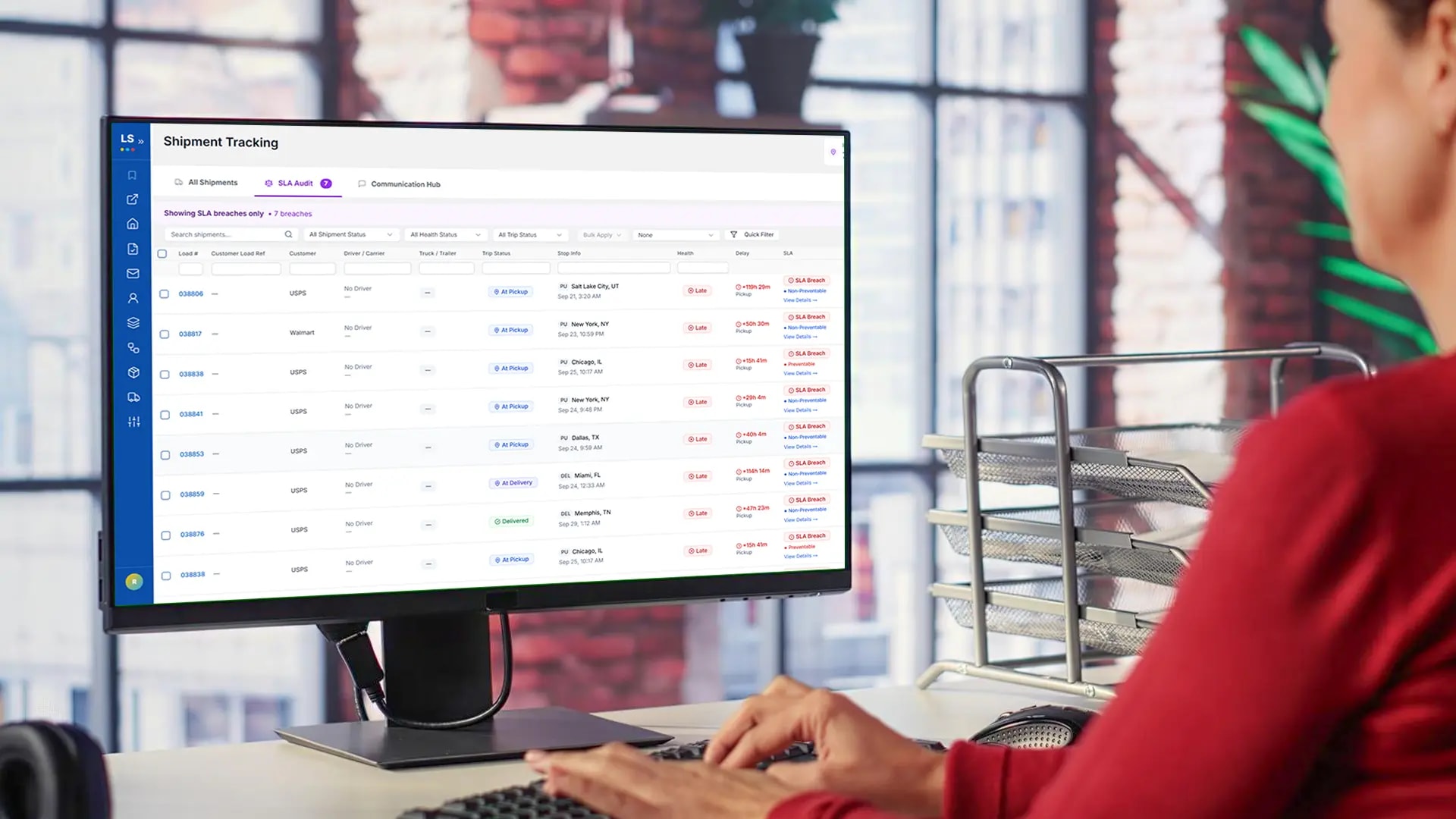
Load 40522 was due at the receiver by 2 p.m. At 2:40, dispatch had heard nothing. The truck's last ELD ping put it eleven miles out, not at the dock. No call, no note, nothing dramatic. The appointment window still had a little grace left in it. Any dispatcher who has run a board for more than a few months knows what a quiet late check-in usually means. It is rarely nothing. This is freight anomaly detection before it has a name: one small deviation, caught early enough to still be cheap.
Twenty minutes later, the same dispatcher saw a carrier bid come in well under the last five closed rates for that lane. Neither event was a crisis by itself. Both were anomalies, small deviations from a pattern, each one needing a decision within minutes. That is the pattern in miniature: catching a deviation while it is still small, before it turns into a missed appointment, a blown margin, or a fraud claim.
This article covers what counts as an anomaly in a freight operation. It covers how freight anomaly detection actually works as a mechanism, and where that work already happens inside a connected TMS.
Key takeaways
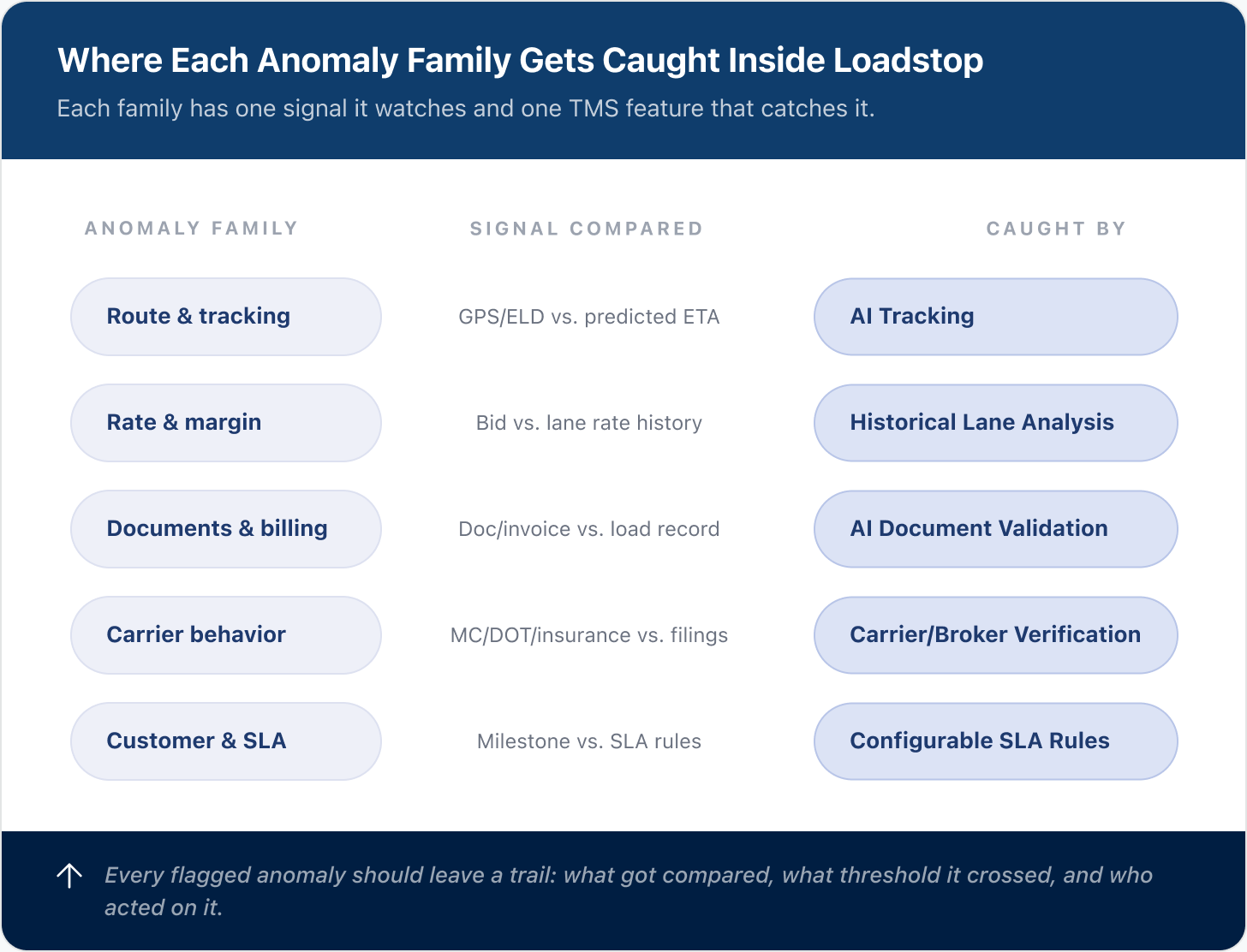
Freight anomalies fall into a handful of repeatable families: route and tracking, rate and margin, documents and billing, carrier behavior, and customer or SLA risk.
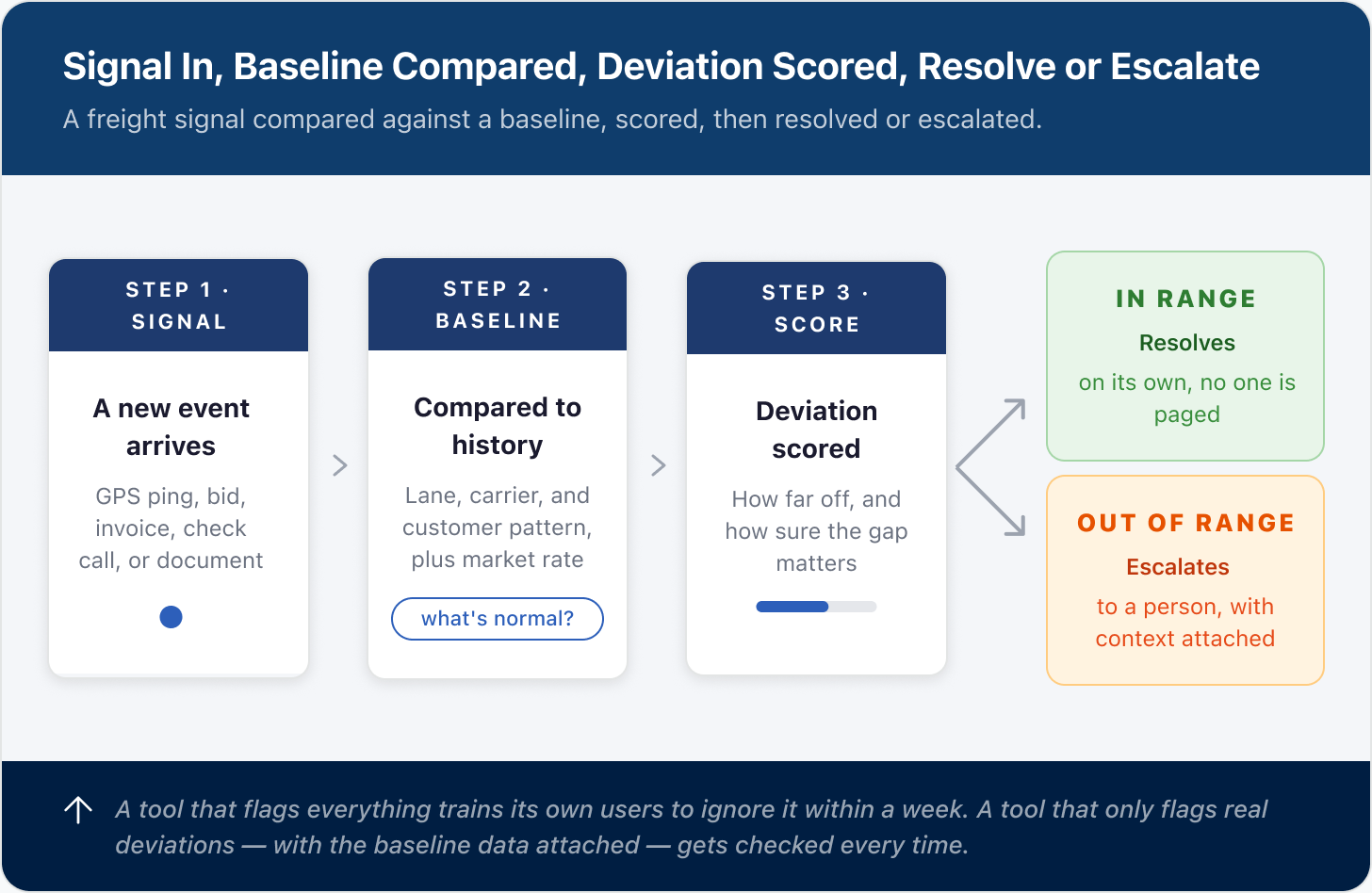
AI anomaly detection works by comparing a live signal against an operational baseline built from lane, carrier, and customer history, then scoring how far it drifted.
Most flagged deviations are not fraud. They are ordinary operational drift that still needs a person to look before it compounds.
A well-built freight exception management system resolves in-policy work automatically and escalates only what actually needs a decision.
Every flagged anomaly should leave a trail: what got compared, what threshold it crossed, and who acted on it.
Inside an AI-powered TMS, this shows up as SLA breach alerts, document validation flags, billing checks, and a task queue, not a separate monitoring product bolted on the side.
What counts as an anomaly in freight operations
An anomaly is not a synonym for a disaster. It is any signal that breaks from the pattern its own history predicted. Some anomalies resolve themselves in the next five minutes. A few are the first sign of something that will cost real money if nobody looks. The work of freight risk detection is telling which is which, fast enough to matter.
Across a typical freight operation, the anomalies worth watching cluster into five families. A truck drifting off its expected corridor is a route deviation. A trailer sitting at a facility well past that dock's normal turn time is a dwell anomaly. Let it cross into billable hours, and it becomes a detention anomaly. A gap in scheduled updates is a check-call anomaly.
A truck leaving its corridor with no explanation trips a geofence exception. On the paperwork side, a proof of delivery that never lands is a shipment milestone mismatch. A rate that doesn't match the signed rate confirmation is a rate mismatch, or an accessorial anomaly if it's an add-on charge that slipped in.
A carrier bid that undercuts a lane's history by a wide margin is a carrier bid outlier. A pattern of late responses or shifting contact details is suspicious carrier behavior, sometimes tied to double-brokering risk. Even a rerouted tender with no documented approval, a tender anomaly, belongs on the same list.
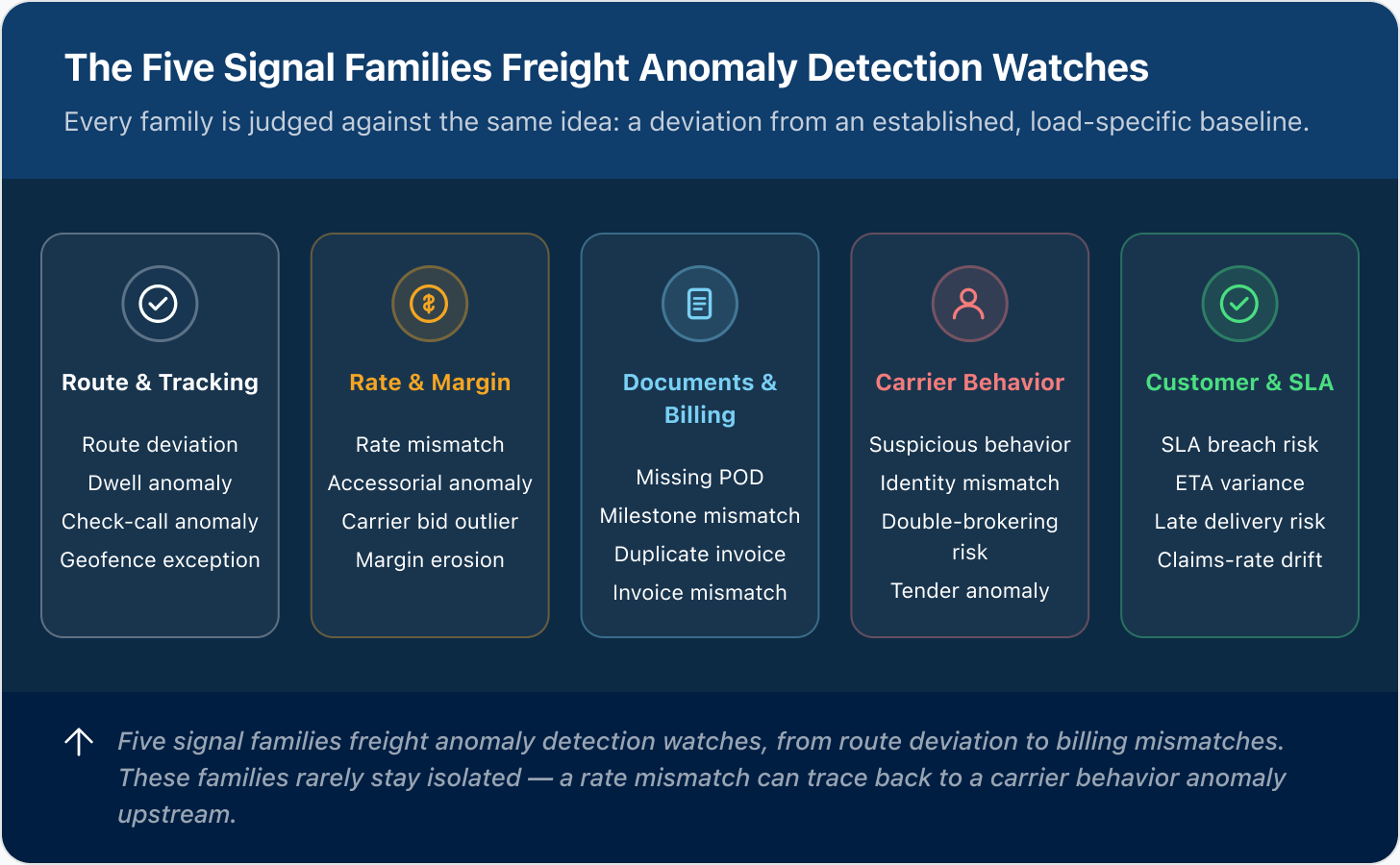
None of these require a stretch of imagination to picture. A rate confirmation edited after a driver already has hands on the freight. A customer whose lane has held a steady margin for a year, then loses ten points in a month with no obvious cause. Every one of them is a deviation from an established pattern. That is the entire definition worth caring about here. It is a wider net than most people mean when they say "AI catches fraud." Five families. One underlying logic.
These families rarely stay isolated. A rate mismatch on one load can trace back to a carrier behavior anomaly upstream, the same carrier that quietly changed its remit-to address last month. A dwell anomaly at a receiver can turn into a customer and SLA problem within the hour if nobody escalates it in time. Watching each family on its own catches some of it. Watching them together, against the same operational baseline, catches the pattern before it spreads across categories.
What "anomaly detection" actually means
IBM defines anomaly detection as "the identification of observations, events or data points that deviate from what is usual, standard or expected, making them inconsistent with the rest of a data set." That definition holds up cleanly in freight. A lane has a typical transit time. A carrier has a typical response window. A customer has a typical claims rate. Freight anomaly detection is the discipline of knowing that pattern well enough to notice, automatically, the moment something breaks it.
That baseline-and-deviation logic isn't unique to freight. Banks use it to catch card fraud. Hospitals use it to catch equipment failures before they happen. What makes freight anomaly detection its own discipline is the mix of signal types involved. Physical location data sits next to a dollar figure, which sits next to a piece of paperwork. Each one needs to be compared against a different kind of history, at the same time.
Logistics anomaly detection and AI exception management describe the same underlying idea from two different angles. One names the pattern break. The other names the workflow that handles it once found. Freight exception management is the practical, day-to-day version of both, the actual process of routing a flagged deviation to the right person before it becomes a service failure.
This is a good place to name what freight anomaly detection is not. It is not TMS anomaly detection bolted on as a separate dashboard. It is not freight operations AI running somewhere in the background where nobody can see its reasoning. Done well, AI freight operations tooling shows its work: which baseline it used, how far the signal drifted, and why it made the call it made. Nothing stays hidden.
Why these signals get missed until they're expensive
A single freight operation runs on a constant flow of signals. Quote emails, tenders, bids, check calls, GPS pings, ETA updates, ELD data, invoices, PODs, carrier responses, accessorials, and customer messages, all moving at once. All of it arrives at once, competing for the same handful of people. A dispatcher with forty active loads cannot personally recheck every ELD ping against every lane's history. A billing clerk cannot manually cross-reference every invoice against every rate confirmation from the last ninety days.
None of this is a knock on the people doing the job. An experienced dispatcher's instinct for "something's off" is real, and it catches plenty. The problem is coverage, not skill. That instinct can only watch the loads currently in front of it. Everything else goes unwatched. A growing operation generates more signals than one person can hold in their head across a full shift. Something has to be watching continuously, or the watching only starts after a customer has already noticed first.
Most of what gets missed this way is ordinary drift, not crime. But the cost of missing the rarer cases is exactly why systematic freight fraud detection earns its keep alongside the routine kind. Cargo theft losses in the United States reached an estimated $725 million in 2025. That is a 60 percent increase over 2024, according to Verisk CargoNet's year-end trend analysis, published in January 2026. Average theft value climbed to $273,990 per incident, up from roughly $202,000 the year before. CargoNet's own outlook expects theft-by-deception schemes, the kind built on misdirected shipments and falsified pickups rather than straight break-ins, to keep growing.
Fraud like that rarely announces itself. It shows up first as a small deviation. A pickup confirmed by an unfamiliar contact. A carrier whose MC number doesn't match its own insurance filing. A load rerouted mid-transit with no record of who approved it. Each one is a freight risk detection case waiting to be caught early instead of found late.
Fraud is the headline case, but it isn't the common one. A detention charge that never gets billed because nobody logged the dwell time is a smaller, quieter loss, repeated across a fleet's whole board every week. A duplicate invoice that slips through AP because two systems didn't compare notes costs real money too, just in smaller, less newsworthy amounts. Billing teams and compliance teams feel this as much as dispatch does. Small losses add up fast. The signal that matters most on a given day is rarely the dramatic one. It's the routine one nobody had time to check.
Where Manual Review Breaks Down First
A single dispatcher watching a single board can absolutely catch a late check-in. What breaks first isn't judgment. It's coverage across shifts, lanes, and departments at once. A pattern one dispatcher would recognize instantly on their own loads is invisible to the next shift picking up that same board cold. A rate outlier a senior broker would catch by instinct means nothing to a new hire three weeks into the job. That instinct took years to build, and the freight doesn't wait for it to form. A document mismatch a billing clerk would catch during a careful review gets missed during a rushed month-end close. There isn't time, then, to check every invoice against every rate confirmation by hand.
None of this means the instinct is wrong. It's not a knock on the people doing the work. It means the instinct needs the same baseline data available to everyone, at the moment they need it, not locked inside one person's memory.
How freight anomaly detection actually works
Strip away the branding, and the mechanism behind any credible AI-powered TMS is the same three steps: build a baseline, score the deviation, then resolve or route it. Three steps. Every time. The same logic already runs underneath how LoadStop automates dispatch, just applied here to a wider set of signals than a single load assignment.
Building the operational baseline
Detection starts with history, not guesswork. A system pulls a lane's typical transit time and rate range. It adds a carrier's performance history and usual response window, plus a customer's normal claims and SLA pattern. All three together become a working operational baseline. A market rate benchmark adds outside context on top of that. A bid isn't just compared to what this one broker paid before, it's checked against what the lane is actually running at right now. Without a baseline, "normal" is just a guess. With one, a system knows a load's normal operating range before the load even ships. That's the whole foundation.
Scoring the deviation
Every new signal, a GPS ping, a bid, an invoice, a check call, gets compared against that baseline close to real time. The comparison produces a confidence score: how far off is this from what history predicted, and how sure is the system that the gap actually matters. A ping five minutes late against a two-hour transit barely registers. A truck fifty miles off its corridor with no check-in does not go unnoticed. The same scoring logic applies whether the signal is a location, a rate, or an invoice line. A small, explainable gap keeps moving. A large or unexplained one gets flagged for review. That's the whole test.
Routing the exception
Anything inside the normal range keeps moving without anyone's attention. Anything that crosses the threshold gets routed to a person, with the context that explains why it was flagged, not just the bare fact that it was. Context changes everything. This human-in-the-loop step is what separates a useful system from a noisy one. A tool that flags everything trains its own users to ignore it within a week. A tool that only flags real deviations, with the baseline data attached, gets checked every time, because every alert has already earned its place on someone's desk.
Where this shows up inside a connected TMS
None of the mechanisms above are theoretical. Inside an AI-powered TMS, it runs as a set of specific, everyday features. Shipment exception detection and route deviation detection run together here, inside the same TMS CoPilot layer. Neither shows up as a separate anomaly-detection product a team has to learn on top of everything else.
That distinction matters operationally. A bolt-on monitoring tool means a second login, a second alert inbox, and a second place for context to get lost between systems. Built-in detection means the same screen that shows a load's status also shows why that load got flagged, without anyone switching tabs to find out.
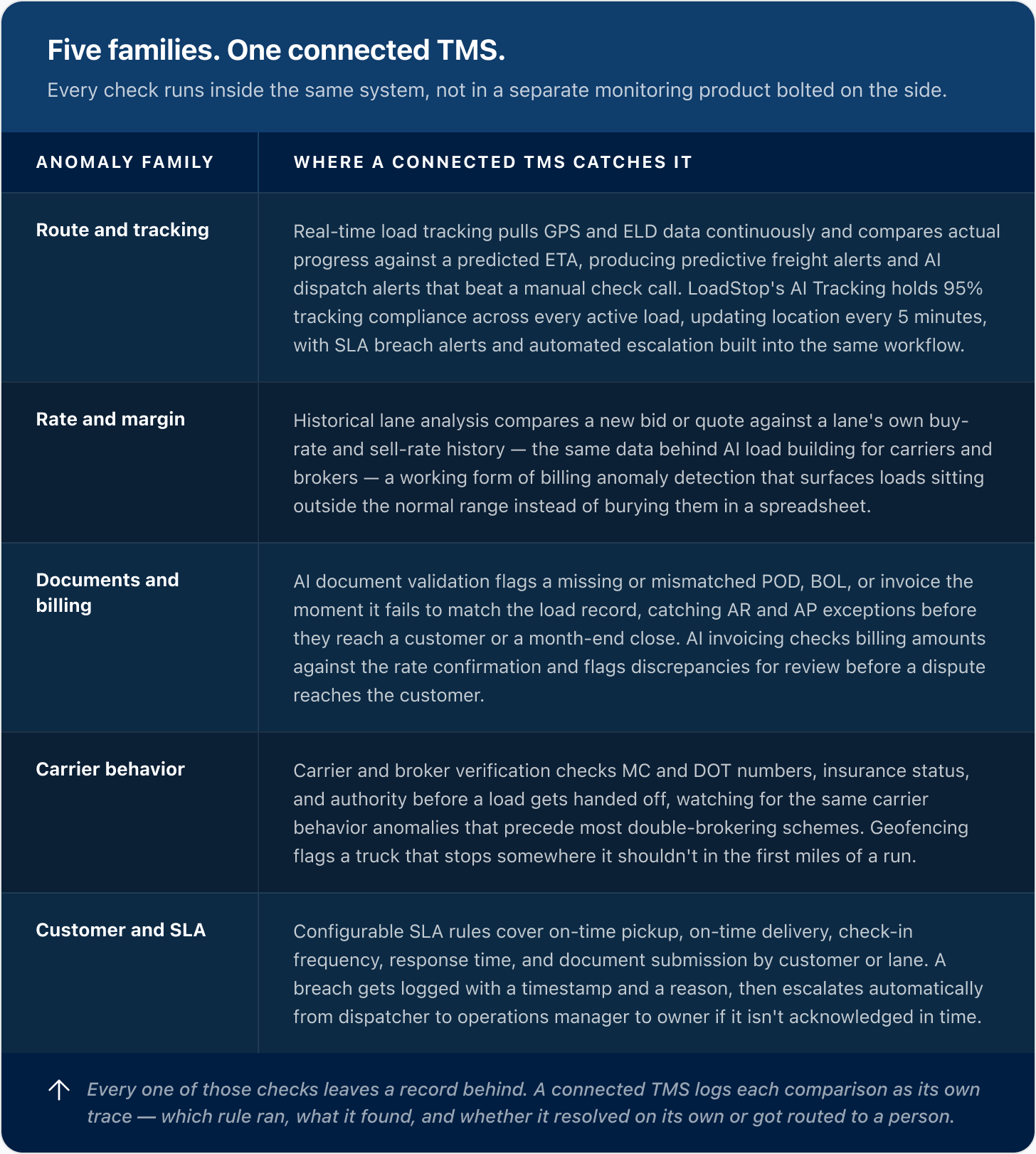
Every one of those checks leaves a record behind. A connected TMS logs each comparison as its own trace. That trace shows which rule ran, what it found, and whether it resolved on its own or got routed to a person. That is what makes the difference auditable instead of anecdotal. A team can look back at exactly which signal triggered a flag and why, instead of relying on someone's memory of what happened that day. No guesswork required.
This is real-time freight visibility applied to more than a single dot on a map. The same comparison logic runs across tracking, rates, documents, carriers, and SLAs at once. That is what turns freight operations automation from a dispatch convenience into an actual exception-management system.
What happens after an anomaly gets flagged
Flagging is only half the job. What happens next is what actually protects a margin or an appointment. It's also the answer to a fair worry: does this mean more dashboards to watch, not fewer fires to put out.
LoadStop's CoPilot layer treats every freight event, an email, a check call, a document, a tracking update, as a trackable signal. It checks that signal against your rules. High-confidence, in-policy work simply runs: the tracking record updates, the document gets filed, the milestone moves forward.
Everything else stops and routes to a person, with the full context already attached, so the human deciding has more information in front of them, not less. Nothing here happens by magic. The goal is fewer things to check, not more, because most of the volume never reaches a person at all. In practice, that means a dispatcher's queue holds the loads that need a decision, not every load that moved today.
A billing team's review list holds the invoices that don't match, not the ones that already cleared. The list isn't bigger. It's shorter, and everything on it has already earned its place there.
That handoff lands in a task queue, where a flagged item carries the reason it needs a look, not just a red flag with no explanation. A carrier bid that needed a second opinion shows up with the detail that triggered the review. A blocked quote request shows up with the specific field that came back missing.
Nobody has to reconstruct why something was pulled aside. The reason travels with the flag. Behind all of it, an audit trail records every action, escalation, and resolution with a timestamp. A dispute six weeks later gets an answer instead of a guess.
That is transportation exception management working the way it should be: quiet on the loads that are fine, loud only on the ones that need a person.
Ready to Detect Freight Anomalies Earlier?
Freight operations generate thousands of signals a day. Catch deviations while there is still time to act with LoadStop.
Schedule a Demo