

Every fleet manager knows the feeling.
A driver finishes a delivery. The paperwork’s done. The next load? It doesn’t pick up until tomorrow or it’s 200 miles away. So the truck hits the road again, empty. Burning fuel. Eating up driver hours. Adding wear and tear. Bringing in zero revenue.
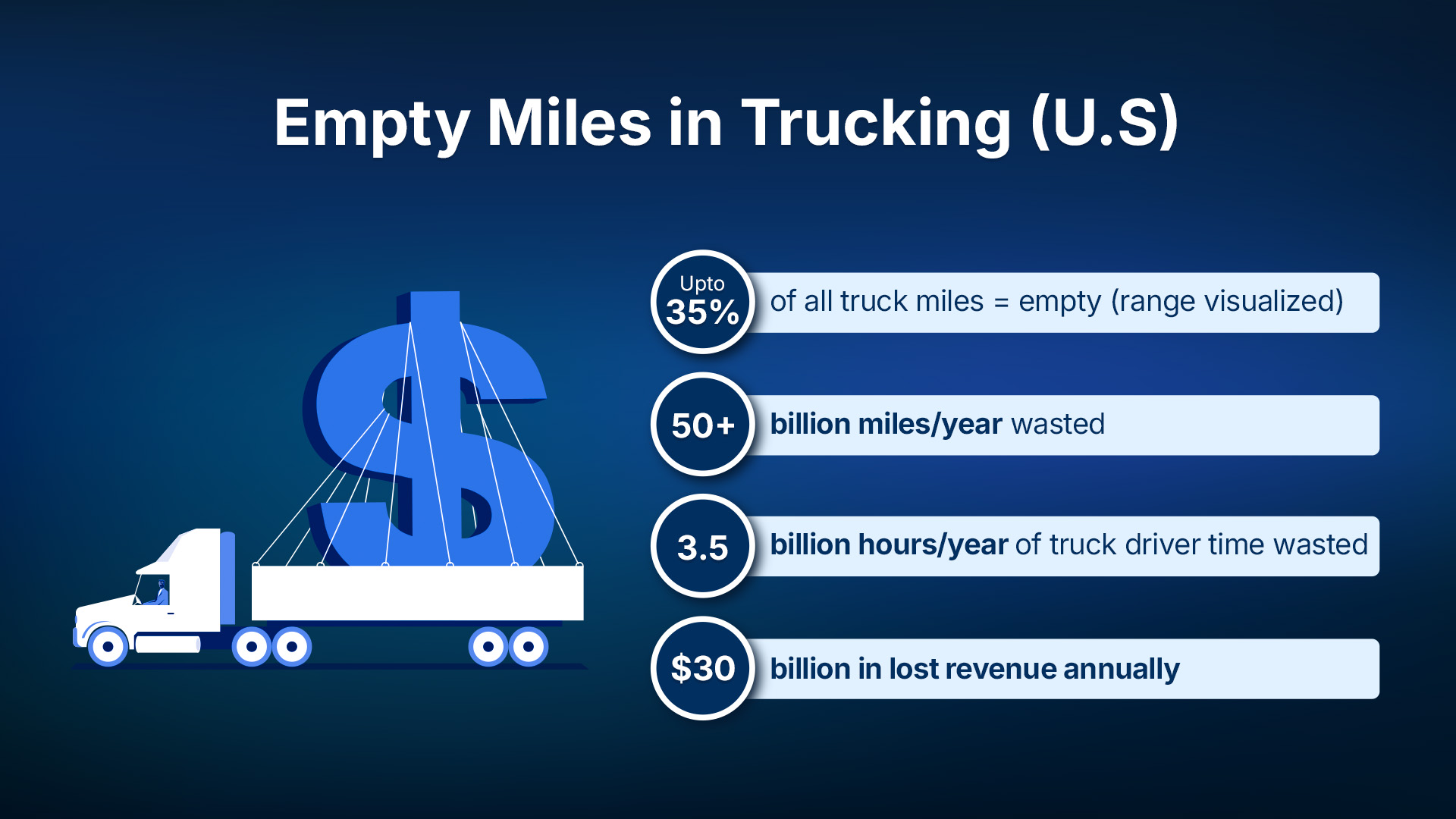
According to recent studies, up to to 35% of all truck miles in the U.S. are driven empty, representing over 50 billion unproductive miles per year across the industry. This is a revenue sinkhole worth nearly $30 billion annually.
In this article, we’ll break down:
- What’s causing deadhead miles
- How much does one mile of empty travel actually cost your fleet
- The operational, financial, environmental, and safety impacts of deadhead
- Traditional Dispatch vs. Smarter Load Management
- How Smart TMS platforms like LoadStop help reduce empty miles at scale
What’s Causing All These Empty Miles?
Empty miles don’t happen for just one reason. Between fragmented tools, limited visibility, and manual dispatch planning, most freight networks today are still disconnected. Here’s what that looks like in practice:
- Shippers post loads on one platform or load board.
- Carriers search on another system, often without knowing what’s nearby or what’s coming up next.
- Dispatchers rely on phone calls, emails, or spreadsheets to plan the next move. This happens often without real-time visibility into trucks, loads, or traffic.
As a result, a truck might finish a job in City A, but the next load isn’t until tomorrow in City B, 200 miles away. That truck drives empty to get there - burning fuel and wasting time.
Even when freight is available closer, the system isn’t smart enough to connect the dots fast enough. Loads and trucks don’t get matched efficiently, and that leads to repositioning miles that don’t make money.
This problem gets worse when:
- Load boards are oversaturated
- There’s no integration between systems (TMS, ELDs, tracking, etc.)
- Planners are manually handling dozens or hundreds of trucks without automation
That’s why empty miles are still so common, because most systems don’t have the visibility into the full network, and therefore, they can’t suggest the best move in real time.
Why Deadhead Miles Matter More Than You Think
The challenge isn’t just the distance; it’s the deadhead cost calculation that hides the true financial toll. Many fleets underestimate their impact because the expenses are spread across operations, not broken out per trip. But the truth is: empty miles can quietly turn a profitable lane into a financial loss.
To understand the scale of the problem, it helps to break down the true cost per mile when a truck moves without freight.
What Does One Deadhead Mile Actually Cost?
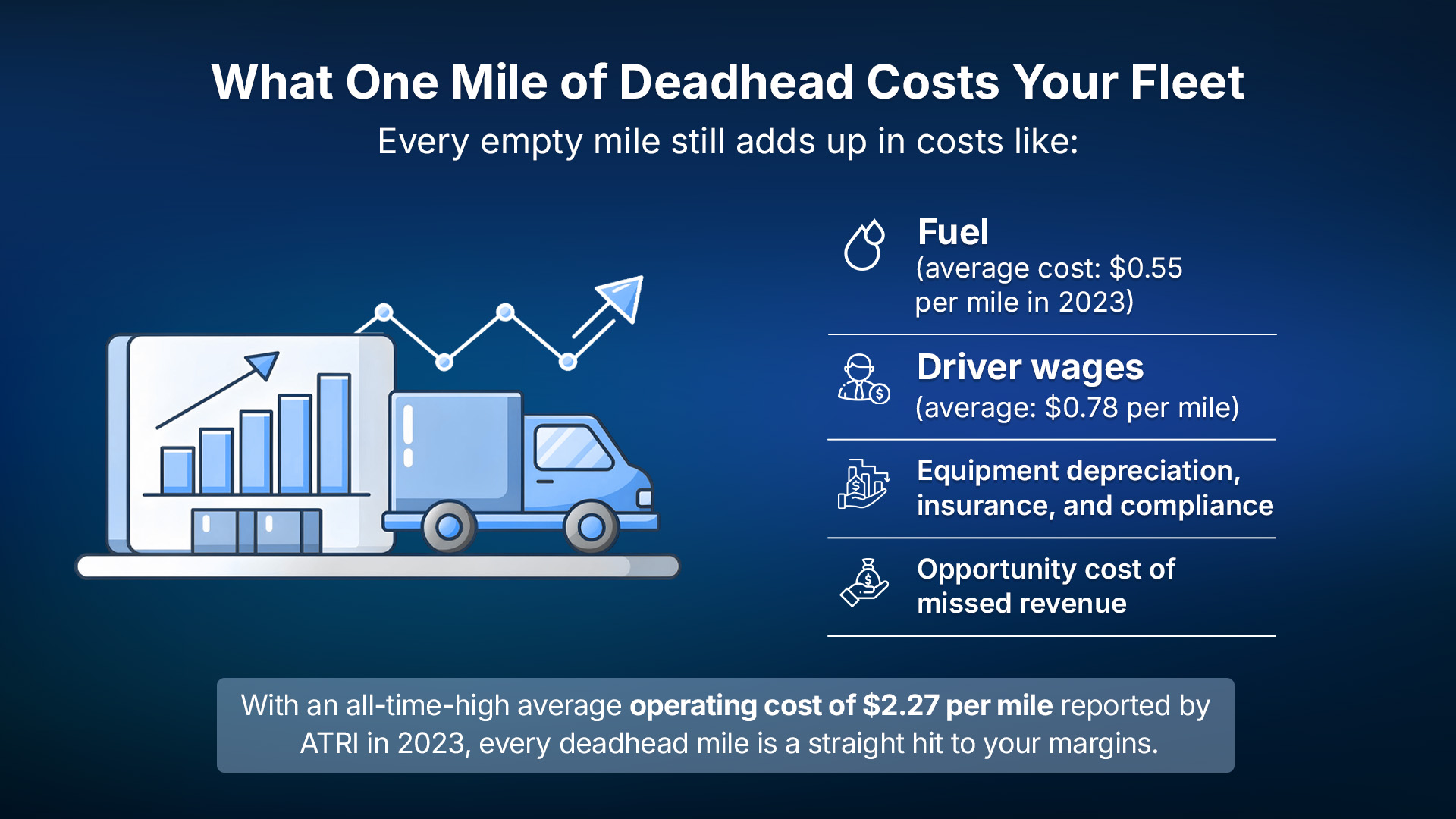
Even without revenue, every mile a truck drives still incurs fixed and variable costs - from fuel and wages to maintenance and insurance.
Here’s what one mile of deadhead typically costs a U.S. carrier today:
But money isn’t the only thing at stake.
Empty miles also disrupt day-to-day operations, reduce fleet visibility, increase safety risks, and drive up unnecessary emissions. This makes them a much bigger problem than just wasted fuel.
Operational Impact:
- Reduced Revenue per Truck: Empty miles increase total cost per trip without adding to revenue, which drags down overall revenue per mile.
- Lower Capacity Utilization: Industry data shows that 16.3% of total fleet miles in 2023 were empty, which means nearly one out of every six miles generated no revenue.
- Harder Load Planning: Many fleets still rely on manual planning, which makes it difficult to consistently find return loads or optimize dispatch planning. As a result, trucks may leave delivery points without another load lined up.
Visibility Gaps:
- Deadhead Often Goes Untracked: Deadhead miles are often not assigned to a specific load. This makes it harder to calculate the actual cost and measure profit per load.
- False Profit Signals: A load may appear profitable based on the rate per mile. But if a truck had to run 200 miles empty to reach the pickup location, that margin could disappear.
Revenue ≠ Profit: Most fleets still measure revenue per load, not true profit per load. Without the ability to track and allocate fuel, driver time, repositioning, and other costs, profitability becomes guesswork.
Safety and Environmental Impact
- Greater Safety Risk: Empty trailers are lighter and more difficult to handle, especially in strong crosswinds or poor weather. This increases the risk of rollovers or loss of control.
- Higher Emissions for No Return: Trucks driving empty still burn fuel, which means more unnecessary emissions with no freight moved.
These problems aren’t happening because dispatchers or planners aren’t doing their jobs. They’re happening because most teams are using tools that weren’t built for today’s freight landscape.
Traditional Dispatch vs. Smarter Load Management
Manual dispatch was never built to handle today’s fragmented, dynamic freight environment. For years, dispatch has run on muscle memory, phone calls, and spreadsheets. And while that worked in a slower, more predictable freight market, today’s environment is far too dynamic for manual planning to keep up.
The Problem with Traditional Dispatch
Many fleets still rely on spreadsheets, phone calls, and gut instinct to run daily operations. While that might work in the short term, it leads to costly inefficiencies that quietly eat into profits.
These inefficiencies stack up quickly. Without real-time visibility or connected systems, dispatchers are often forced to make decisions based on limited information. Loads get booked reactively.
Trucks end up sitting idle or driving long distances without freight. And even when capacity is available nearby, most systems aren’t smart enough to connect the dots. The result? Wasted miles, lost time, and missed revenue.
In fact, a 2023 survey by Inbound Logistics notes that up to 35% of truck miles are still empty, largely due to misaligned planning and lack of coordination between carriers and shippers.
The Shift Toward Smart Load Management
Modern fleets are adopting Smart TMS platforms that combine automation, AI, and visibility into one system. This eliminates the need to jump between apps or rely on gut instinct.
Smart dispatch systems help fleets:
- Match loads in real time, based on driver location, trailer type, and hours of service
- Reduce planning time by automating repetitive tasks
- Simulate route combinations to avoid long repositioning hauls
- Track profit per load, not just rate per mile
For example, Uber Freight reported saving over 4 million empty miles per year using automated load bundling and route pairing technology.
How Smart TMS Like LoadStop Helps Reduce Empty Miles at Scale
Smart TMS platforms like LoadStop directly address the core drivers of deadhead:
-
Real-Time Load and Truck Visibility
Knowing where your trucks are and what’s available nearby is the first step to cutting empty miles. LoadStop gives dispatchers real-time visibility by pulling live location data from ELDs, driver app check-ins, and automated milestone updates, all layered with AI-driven predictive ETAs. This enables dispatchers to line up the next load before a truck even finishes its current run.
For example, it can show that Truck #5 will empty out in Dallas at 4 PM, and simultaneously show a list of available loads within a 100-mile radius that can be picked up by that evening.
-
AI-Powered Load Building
LoadStop’s AI Load Build feature automatically extracts shipment details from emails, PDFs, and broker systems, populating TMS fields without manual typing. This allows dispatchers to plan faster and with more consistent data, avoiding mismatched or last-minute loads that force deadhead repositioning.
- 90% reduction in load entry time for carriers
- 60% fewer manual data entry tasks for brokers
- Enables dispatchers to plan further ahead with cleaner load data
That’s why more fleets are adopting smart TMS tools that control costs
-
Automated Carrier Bidding
LoadStop’s AI Bid Automation sends bulk bid requests to approved carriers and collects responses automatically. Dispatchers get faster quotes and can book loads closer to the truck’s real location.
- 25% increase in carrier bid activity
- 40% faster response times
- Reduces the risk of long-distance empty runs for last-minute loads
-
Built-In Analytics
Most TMS platforms track loads. LoadStop tracks profitability. Its analytics modules let fleet managers measure:
- Deadhead miles by lane
- Cost per mile per shipment
- Margin leakage and missed backhaul opportunities
This makes it easier to fix planning patterns and load matching strategies over time and reduce deadhead structurally, not just tactically.
-
Seamless Load Board and Carrier Integration
With more than 120+ integrations (DAT, TruckStop, RMIS, FourKites, and others), LoadStop reduces the time to post, book, and onboard. This means trucks are not sitting idle waiting on paperwork, and dispatchers do not scramble for last-minute freight that results in empty miles.
LoadStop’s Impact on Reducing Deadhead
Fleets using LoadStop report:

Up to 30 percent increase in operational efficiency
2x to 4x productivity gains in dispatch and operations
Smarter pairing of loads means less empty movement
Better analytics means fewer blind spots in deadhead patterns
Automated planning means more miles filled with revenue
Final Thoughts
Deadhead miles are not a cost of doing business; they are an addressable inefficiency. And the numbers don’t lie:
- 50+ billion empty miles per year
- $30 billion in lost freight revenue
- $2.27 operating cost per empty mile
- Up to 70% of dispatcher time spent on manual tasks
Smart TMS like LoadStop has made it possible to:
- Cut deadhead rates by 3–5% (or more)
- Increase driver productivity without increasing fleet size
- Lower cost per mile with no compromise on service
Deadhead isn’t just a dispatch problem; it’s a profitability one. With the right TMS in place, you can reduce empty miles, improve margins, and scale your business more efficiently.
Ready to make deadhead a thing of the past? Start with visibility. Build on automation. And let data drive smarter moves every mile of the way.