
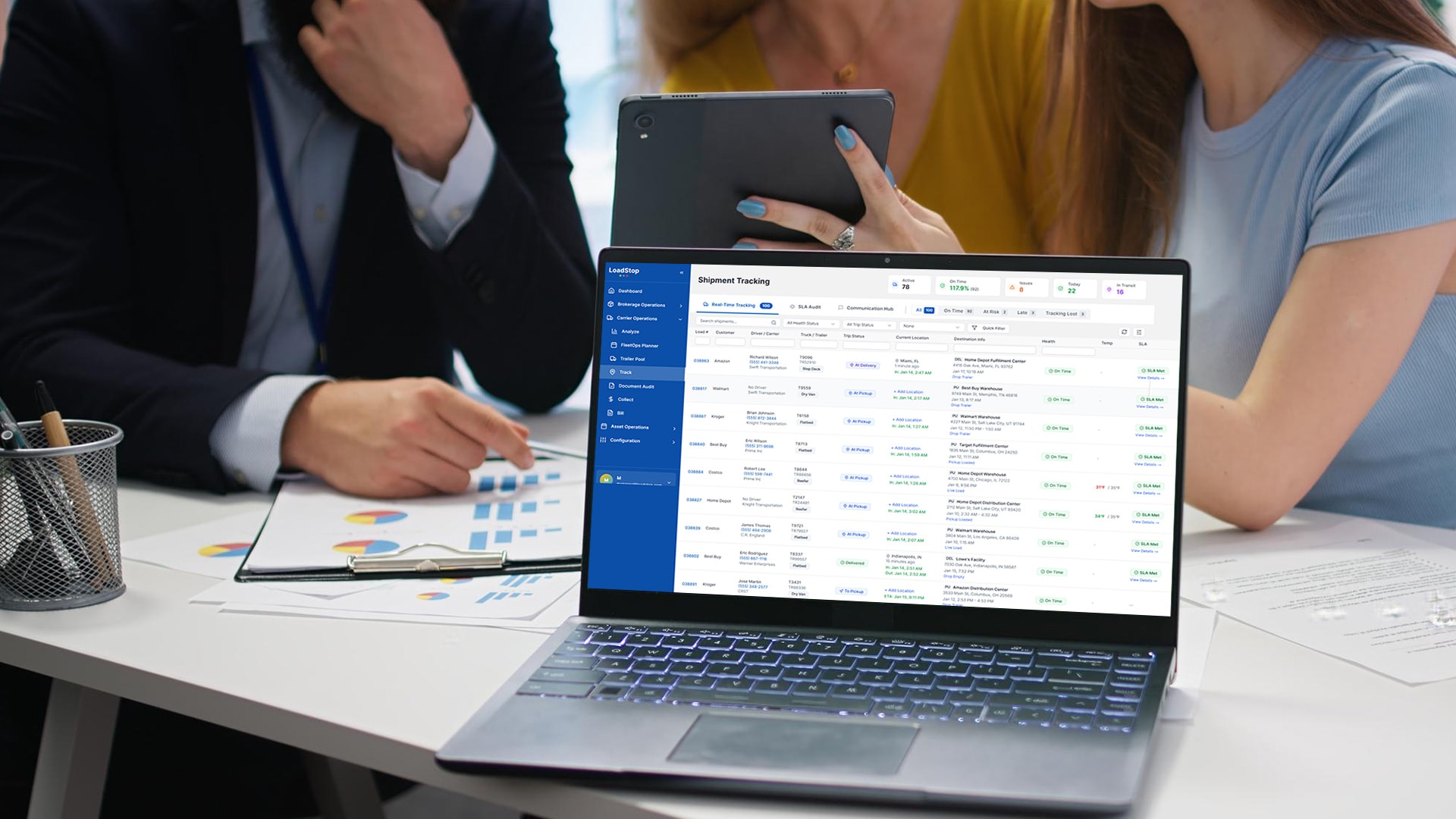
Shippers have always wanted to know where their freight is. What’s changed is the standard they expect and the penalties they attach when they don’t get it.
Today, real-time load tracking isn’t a “nice-to-have” service add-on. For many shipper operations teams, it’s an onboarding requirement, a scorecard line item, and a day‑to‑day SLA expectation, right alongside on‑time pickup and on‑time delivery.
This shift matters because it lands directly on you: the carrier who has to execute and communicate, and the broker or 3PL who has to manage the shipment end‑to‑end.
In this guide, we’ll break down what real-time tracking actually is, how it works, what shippers really mean by “visibility”, and why carriers and brokers need it to protect shipper relationships.
Then we’ll shift to the practical part: how LoadStop makes shipment visibility simple across ELDs, driver app, agentic workflows, and AI-powered tracking.
Real-Time Load Tracking & What It Really Means?
At a basic level, real-time load tracking is the ongoing ability to see a shipment’s location and status after it has left the origin, plus enough context to understand whether it’s on plan or at risk.
Gartner describes Real-Time Transportation Visibility Platforms (RTTVPs) like Project44, FourKites, and FarEye as core channels for real-time location updates and status insights, where these platforms typically obtain data via integrations (API/EDI), telematics feeds, and other technologies or apps.
So, in simple words, real-time tracking is a system. You’re not buying a map; you’re building a dependable stream of location + milestone events that protects your SLA performance when things get messy.
The Key Difference vs Traditional Tracking is Timing & Reliability
Old-style tracking often relies on periodic events (e.g., manual updates or delayed EDI messages). Modern approaches pull live telematics or mobile location signals and turn them into usable milestones and alerts.
Inbound Logistics contrasts newer real-time platforms (using onboard GPS plus mobile tracking and predictive analytics) with “outdated EDI” approaches, and highlights the value of proactive exception management.
What Shippers Usually Expect You to Track?
Their expectations are not just a dot on a map, but “events” that map to their warehouse and receiving reality: dispatched/en route, arrived at pickup, departed pickup, arrived at delivery, delivered, and sometimes “empty” or return-to-yard.
Many major freight management platforms’ tracking policy, for example, spells out required status updates across the load lifecycle (including dispatched before pickup, arrived/departed pickup, arrived at drop-off, delivered).
Where Does the Data Come From?
The usual data sources fall into three categories:
- Telematics/ELD (GPS Truck Tracking System Data)
- Driver Mobile App (Location & Confirmations)
- System-to-System Integrations (TMS/EDI/API)
| Tracking Method | Location/Status Source | Best For | Common Trade-offs |
|---|---|---|---|
| ELD/Telematics Feed | Live vehicle data via system integration | High consistency and low driver friction when integrated | Requires setup, permissions, correct unit mapping, and reliable data flow |
| Driver App Tracking | Phone location + driver taps for milestones | Smaller fleets, mixed equipment, fast onboarding | Needs driver participation and correct permission settings |
| Waterfall/Backup Tracking | System chooses ELD first, then app, then text-based confirmation | Hitting compliance across a diverse carrier base | Each fallback step can reduce granularity vs fully automated sources |
| EDI/API Status Messaging | Electronic events back to shipper/broker systems | Standardised milestone communication for enterprise workflows | Can be delayed or incomplete if not instrumented well |
Why Shippers Demand It & How SLAs Changed?
Shippers don’t demand visibility because it’s trendy. They demand it because modern supply chains operate at a speed where silence becomes risk.
McKinsey notes that track-and-trace capabilities help provide customers “unprecedented transparency”, including systems that send detailed updates throughout the order lead time. In an omnichannel world, customer expectations for fast delivery and high service levels have pushed organisations to redesign how they manage speed and reliability.
Another McKinsey research highlights that customers expect products “anytime and anywhere” with a very short time between order and delivery. This becomes a primary service differentiator.
At the operational level, shippers increasingly run some form of control tower thinking: they want connected, near-real-time visibility and the ability to manage exceptions proactively.
Deloitte describes a supply chain control tower as an integrated set of tools and techniques to proactively manage end-to-end supply chains in real time through connected visibility, proactive exception management, and predictive insights. Accenture similarly frames connected supply chain solutions as providing real-time visibility and control, often via a control tower approach.
This is why “Visibility SLAs” have become a real thing. Shippers don’t just measure whether you were late. They measure whether you warned them early enough to protect their dock plan, labour, production schedule, or customer promise.
Visibility matters because shippers themselves are under pressure. Accenture research highlights that a lack of visibility hampers supply chain capabilities, and reports that only around three in ten supply chain executives were very confident in their ability to foresee and respond to future disruptions and bottlenecks. When the shipper’s internal world is uncertain, they lean harder on partners who can keep them informed.
A simple way to think about it: on-time performance is the outcome; real-time visibility is the early-warning system. Here’s what shipper-focused SLA compliance often looks like in the real world, and why tracking is the mechanism underneath it.
| Shipper SLA Expectation | What It Looks Like? | How Does Real-Time Visibility Support It? |
|---|---|---|
| Milestone Updates | Arrived pickup, departed pickup, arrived delivery, delivered must be timely and clear | Automated status feeds reduce missed updates and create consistent event timelines |
| ETA Accuracy | Shipper plans labour and dock doors around the predicted arrival | Visibility platforms combine location + live conditions to support predictive ETAs |
| Exceptions & Alerts | Shipper wants proactive alerts for delays, route issues, or stalled movement | Predictive analytics and proactive exception management help identify risks early and enable faster, informed responses to disruptions. |
| Detention/Dwell Visibility | Shipper wants to reduce surprises at the dock | Geofencing can alert warehouses to impending arrival and updated ETAs |
Why Carriers Need Real-Time Load Tracking to Win Shippers?
Carriers sometimes hear “tracking” and think “extra admin”. Shippers hear “tracking” and think “reliability”.
Here’s the carrier reality: you can’t control every delay (traffic, weather, facility congestion). But you can control how quickly you detect risk and how early you communicate it. That’s what protects your scorecard and your future tenders.
McKinsey highlights that RTTVPs help manage customer expectations by giving them a near-real-time view of shipment location, and it estimates broad adoption of RTTVPs across carriers in the US. In other words: visibility is no longer niche; it’s becoming standard operating equipment.
Here, Carriers benefit in three immediate ways:
First, fewer interrupts for drivers and dispatch. When automated tracking is working, a major freight platform states it does not expect to call drivers or dispatchers for tracking updates, but expects automated tracking to reduce tracking check calls and emails by itself. This is not just convenience; it’s safety and focus.
Second, less “blame fog” in disputes. When location and milestone events are documented, it’s easier to show arrival times, dwell windows, and handoff points. LoadStop’s ELD-focused approach emphasises pulling data elements that matter operationally, like lat/long tracking and hours-of-service signals, so teams can stay ahead of constraints.
Third, you become easier to work with. Inbound Logistics describes the daily chaos many shipping teams still face (calls, websites, spreadsheets, endless “where’s the truck?” queries) and positions real-time tracking as the only antidote, especially when the shipper is managing a large carrier base. Carriers who reduce this chaos become “Shipper of Choice” by default.
A final point carriers often miss: the ELD mandate created a baseline of digital data in the market. FMCSA explains the ELD rule applies to carriers and drivers required to keep records of duty status, and defines an ELD as technology that automatically records driving time. Regulations also specify that ELDs automatically record key data elements, including geographic location information.
That means carriers already sit on valuable location and compliance signals. The modern service expectation is simply to activate and share those signals in a shipper-friendly way.
Why Brokers & 3PLs Need Real-Time Load Tracking to Protect Service Levels?
Brokers and 3PLs live and die by service perception. You can execute a perfect cover and still lose the account if the shipper feels blind.
From a broker’s perspective, real-time load visibility is how you turn “I booked capacity” into “I delivered a predictable outcome”. That includes customer communication, internal operations, and carrier relationship management.
Inbound Logistics notes that modern real-time tracking solutions don’t just provide location; they also alert you to potential issues, support proactive action on loads, and enable performance analysis over time to target systemic problems. This is exactly what brokers need: operational leverage at scale, without hiring a bigger tracking team.
Visibility is also how brokers meet shipper expectations around self-service. Providing shippers with their own portal for real-time visibility and a “white-glove service” experience is the key here and LoadStop automatically covers this for every milestone and ETA update.
And yes, visibility intersects with fraud risk. Some broker tracking offerings emphasise proactive alerts for suspicious behaviour (detecting device anomalies or location inconsistencies) and verifying that tracking begins before sensitive pickup details are released. Even if your primary aim is SLA compliance, these controls matter because a stolen or misrepresented load becomes the worst SLA failure of all.
Finally, brokers need tracking because large networks increasingly formalise “tracking compliance” as a requirement. Many explicitly expect carriers to provide timely tracking updates through automated sources and list the milestone statuses it requires. Brokers supporting shippers on those platforms need a repeatable way to collect, normalise, and share tracking data without living in check-call chaos.
How LoadStop Delivers Real-Time Load Tracking Across Your Network?
LoadStop treats tracking the way shippers experience it: a combination of live visibility, automated milestones, proactive alerts, predictive ETAs, and automated workflows that keep everyone aligned: carrier, broker, and shipper.
LoadStop’s tracking foundation is multi-source by design. LoadStop simultaneously integrates multiple tracking modes (including ELD tracking, trailer tracking, mobile tracking, rail tracking, and temperature tracking) so teams can “illuminate exceptions” and improve customer experience through integrations. This matters because shipper networks are messy: not every carrier has the same tech stack, and not every load has the same visibility requirements.
Predictive ETA and proactive exception management are built into the workflow. LoadStop uses predictive ETA to reduce uncertainty, geofencing to automate notifications and actions, check call automation to keep each party updated, and detention tracking to identify and track detention time and support fair billing. These features map directly to shipper SLA expectations: accurate ETAs, milestone reliability, and documented dwell/arrival windows.
LoadStop for Carriers
Carriers need two things simultaneously: low driver friction and high shipper compliance.
LoadStop’s Driver App focuses on driver-dispatcher collaboration and includes one-tap load acceptance, in-app status updates (picked/delivered/delayed), real-time tracking visibility for dispatch, and fast document upload for BOL/POD workflows. This matters because documentation and status timeliness often sit in the same SLA conversation.
On the telematics side, LoadStop positions ELD integrations as a way to connect, translate, and activate real-time ELD data. It uses secure APIs to fetch live GPS coordinates, HOS status, and duty statuses “the moment they change”, supporting smart ETA predictions and detention monitoring with alerts.
This is exactly the kind of low-touch automation carriers need: fewer manual check-ins, fewer “where are you?” calls, and fewer surprises.
LoadStop for Brokers
Brokers need consistency and scale. When you’re managing dozens (or hundreds) of carriers, tracking must remain reliable even when one data source goes silent.
This is where gap coverage becomes a key differentiator. Modern AI-powered tracking, like LoadStop’s AI Tracking, connects multiple tracking inputs, including ELDs, telematics, trailer tracking, and other visibility integrations. It uses AI to detect when tracking data becomes inconsistent or stops updating.
When gaps occur, the system automatically reaches out to drivers or carriers via phone, email, or text to capture missing updates. These updates are then unified into a single real-time view, supported by proactive alerts and predictive ETAs.
This “Gap Fill” matters for brokers because it’s the difference between: You telling the shipper, “We’ll check and get back to you,” and you telling the shipper, “Here’s the updated ETA and the reason for the variance.”
LoadStop also supports auto-updating tracking statuses from milestones, so operations teams don’t have to manually toggle status fields whenever new milestone data arrives. These small details have a big downstream effect: cleaner customer updates, better internal dashboards, and fewer workflow breakdowns.
LoadStop for Shippers
Even when shippers aren’t the direct buyer of your TMS, they’re the ultimate judge of your service.
LoadStop’s tracking design includes capabilities that matter to shipper teams: customer-based preferences for updates and a customer tracking portal to provide real-time shipment visibility, reduce manual follow-ups, and build trust between shippers, carriers, and brokers. This mirrors the direction the broader market has taken: visibility is increasingly expected to be shareable and self-serve.
Shippers who care about the operational consequences of visibility know how important this is and depend on real-time visibility to anticipate problems and proactively manage disruption. The best tracking approach for shippers is the one that works for their broker and carrier mix and your own SLA language. A trifecta seamlessly works together in sync and LoadStop is one of the first proponents of this approach.
Turning Visibility into Shipper Trust
Shippers demand visibility for one reason: it reduces uncertainty. And in a world of tight delivery windows, labour constraints, and constant disruption, uncertainty is expensive.
For carriers, tracking protects shipper scorecards, reduces check calls, and turns your operation into a predictable partner, not just a truck. For brokers and 3PLs, it’s the backbone of customer experience: fewer blind spots, faster exception response, and a cleaner story when things go sideways.
Most importantly, real-time load tracking is no longer about proving where the truck was. It’s about proving you’re in control of what happens next with ETAs you can stand behind, milestones your customers can trust, and automation that scales without burning out your team.
Regardless of the technology you deploy, visibility alone informs. Visibility paired with action transforms operations and builds lasting customer confidence.