

Double entry is one of the fastest ways to lose time, accuracy, and margin in trucking operations. It shows up when dispatchers and back-office teams have to retype the same load details across load boards, a TMS, an ELD portal, accounting software, factoring portals, and fuel or toll platforms.
This is not a small problem. Manual work still consumes a large share of logistics operations. Research shows that around one-third of logistics workers spend more than 50 percent of their time on manual and repetitive tasks, such as data entry and spreadsheet updates. When teams are busy copying data between systems, operational efficiency suffers.
The cost is not just labor. Bad or duplicated data creates downstream errors in tracking, billing, and customer communication. Gartner estimates that poor data quality costs organizations $12.9 million per year on average.
While that number spans multiple industries, trucking workflows follow the same pattern: people spend hours fixing errors, reconciling mismatched systems, and correcting problems that started with manual re-entry.
The solution is not “be more careful.”
The solution is dispatch automation through TMS integrations.
This guide explains:
- What double entry looks like in real trucking workflows
- Which TMS integrations eliminate it
- How LoadStop enables automated load management before, during, and after the load
What Double Entry Looks Like in Dispatch and the Back Office
Double entry is not just typing a load twice. It includes any workflow where a human has to manually move information between systems to keep them aligned.
Where Double Entry Happens in the Load Lifecyle
1/3 of logistics workers spend over 50% of their time on manual tasks like data entry.
Poor data quality costs $12.9M per year on average.

Load Sourcing
Load found on DAT/Truckstop.
Manual retype stops, equipment, rate.

Dispatch
Load rebuilt in TMS.
Edits happen twice.

Tracking
Status updated via calls.
ETAs guessed and re-entered.

Documents
Docs stored in one system.
Uploaded again in another.

Billing
Invoice created in TMS.
Re-entered in accounting.

Payment
Factoring portal upload.
Fuel and toll reconcialiation.
Common examples include:
- Finding a load on DAT or Truckstop, then recreating the load in your TMS
- Updating load status internally, then repeating the update in a customer portal
- Creating invoices in your TMS, then re-entering them in QuickBooks
- Uploading invoice documents to a factoring portal even though documents already exist in the TMS
- Manually entering fuel and toll transactions into settlement or reporting tools
As fleets grow, double entry becomes a bigger problem. It does not just waste time that could be used on more productive work like planning loads, helping drivers, or fixing real issues. It also increases the chance of mistakes.
Every time someone copies a pickup time, retypes a rate, or updates a load status by hand, there is room for error. Those small mistakes can quickly turn into bigger problems, such as:
- Missed pickups or deliveries because appointment times were entered incorrectly
- Incorrect or delayed invoices when rates or extra charges do not match the rate confirmation
- Slower payments when invoice packets are missing documents or have wrong information
- Untracked costs when fuel, tolls, or lumper charges are entered late or forgotten
- Confused customers when tracking information does not match what dispatch sees
How TMS Integrations Eliminate Double Entry
A modern transportation management system should be built to handle recurring tasks through intelligent automation, reducing manual intervention. But a TMS alone cannot eliminate duplicate entry by itself. It needs logistics system integrations so data can move automatically between:
- systems where data originates (load boards, ELDs, fuel cards, tolling platforms)
- systems where data is consumed (accounting, factoring, customer visibility platforms)
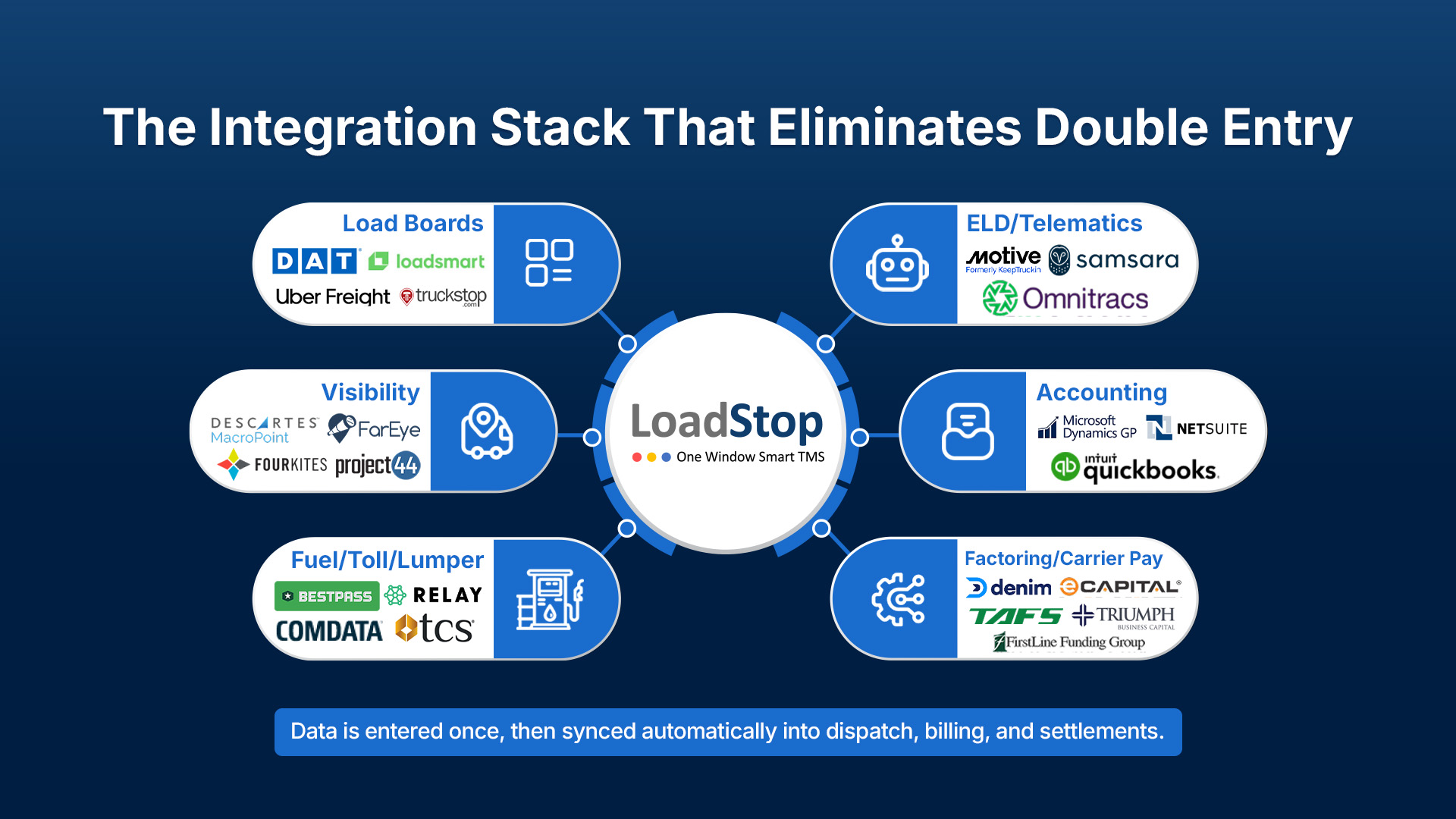
This is where API integrations for TMS make the difference. LoadStop’s integration ecosystem is designed to support real-time data sync, shipment data synchronization, and logistics workflow automation across the full freight lifecycle.
The Fastest Way to Eliminate Double Entry from Your Load Lifecycle
The easiest way to understand automated load management is to break it into three phases:
- Before the load: load sourcing, load posting, onboarding
- During the load: tracking, visibility, equipment location
- After the load: billing, payment, factoring, expenses
This structure makes it clear where automation removes manual processes in logistics and where teams see the fastest return.
Before the Load:
Eliminate Duplicate Load Creation With Load Board Integrations
LoadStop integrates with major load boards and sourcing platforms, including DAT, Truckstop, C.H. Robinson, Loadsmart, and Uber Freight. It also supports load posting through DAT LoadPosting and Truckstop LoadPosting using API integrations.
Double entry eliminated:
Without load board integration, dispatchers typically:
- Find a load on a board
- Copy pickup and delivery details
- Retype rates and equipment requirements
- Manually add reference numbers
- Rebuild the load record inside the TMS
This is where with help of integrations, you can reduce data entry errors. A missed appointment time or rate detail at dispatch can quickly turn into a billing dispute later.
Why This Matters for Pricing and Saving Time
Load sourcing directly impacts pricing decisions. DAT’s RateView Analytics is based on over $1 trillion in actual freight transactions and updates rates daily. When load and rate context sit closer to dispatch workflows, teams move faster and avoid the back-and-forth edits that create duplication.
Operational Outcome
With proper load board integration, a load is created once and reused for dispatch, tracking, billing, and settlement without retyping. This is a foundational step to eliminate double data entry in TMS workflows.
During the Load:
Reduce Manual Updates With ELD, Asset Tracking, and Visibility Integrations
LoadStop integrates with leading ELD providers such as Motive, Samsara, Geotab, Omnitracs, Verizon, and JJ Keller. These integrations pull real-time data including:
- Location
- Hours of Service
- Odometer readings
- Fleet status
Double entry eliminated:
- Manual check calls
- Manually updating status events
- Retyping timestamps used for detention and service metrics
- Re-keying mileage and odometer-based calculations
When real-time data drives dispatch updates, teams shift from repetitive updates to exception-based management.
Asset and Trailer Tracking Prevents Equipment-Related Duplication
Asset tracking integrations with providers like Spireon, Skybitz, TGI, Thermo King, and Orbcomm eliminate:
- Tracking trailers in separate systems or spreadsheets
- Re-entering equipment details for dispatch and visibility
- Manually reconciling which trailer is where
Better equipment visibility directly improves operational efficiency in logistics.
Visibility Integrations Reduce Duplicate Customer Updates
Visibility integrations such as FourKites, Descartes MacroPoint, Project44, and FarEye automatically sync milestones and status updates.
Double entry eliminated:
- Updating customer portals separately from the TMS
- Repeated “where is my load” response workflows
- Mismatches between internal and customer-visible status
This supports real-time data sync and improves service consistency without adding manual work.
After the Load:
Eliminate Duplicate Billing, Payments, and Expense Entry
LoadStop integrates with accounting platforms like QuickBooks, NetSuite, and Microsoft Dynamics GP.
Double entry eliminated:
- Operations create the invoice in the TMS
- Accounting recreates it in accounting software
- Payment status is tracked separately
- Errors require reconciliation
Industry benchmarks show invoice processing costs range from $1.77 per invoice for top performers to $10.89 for bottom performers, highlighting how automation reduces rework. Accounting software integration helps reduce manual data entry in logistics and shortens billing cycles.
Factoring Integrations Speed Up Cash Flow
LoadStop supports factoring integrations using API, FTP, SFTP, and email with providers such as RTS Financial, Triumph Business Capital, Apex Capital, TAFS, TAB Bank, and others.
Double entry eliminated:
- Downloading invoices and documents from the TMS
- Uploading them to factoring portals
- Tracking submissions in spreadsheets
Directly transferring invoice data from the system of record speeds up payment cycles and reduces data-entry errors.
Fuel, Toll, and Lumper Integrations Remove High-Volume Manual Work
Fuel card integrations with EFS, Comdata, Pilot Flying J, QuickQ, BVD, Motive Fuel Card, and Relay eliminate:
- Manual fuel entry
- Fuel statement reconciliation
- Data cleanup for settlements and reporting
Toll integrations with PrePass and BestPass remove duplicate toll entry, while Relay Lumper integration prevents re-entering lumper charges and receipts.
Support Processes: Reduce Repeated Admin Work Across the Business
Carrier onboarding integrations with RMIS and Highway reduce:
- Re-entering carrier profiles
- Manual compliance checks
- Inconsistent carrier status across systems
Driver onboarding through these integrations removes repeated entry of driver details and documents.
How to Prove You Have Eliminated Double Entry
To make the value of automated load management measurable, track these KPIs:
- Touches per load: how many times data is manually retyped
- Invoice cycle time: delivery to invoice sent to payment
- Invoice rework rate: percent of invoices needing correction
- Check calls per load: should drop sharply with ELD integration
- Reconciliation hours per week: fuel, toll, factoring, and accounting
Reducing these numbers directly improves margins and supports smarter cost control, a concept explored further in this guide on smart TMS systems that control costs. It also makes it easier for fleets that can not measure profits per load efficiently to get a clear picture of which customers, lanes, and assets are really profitable, because the cost and revenue data is consistent across systems instead of being spread across spreadsheets.
Final Thoughts
Eliminating double entry is one of the highest-ROI dispatch automation moves a fleet can make. It helps reduce manual data entry in logistics, lowers errors, improves customer visibility, and speeds up billing and payments.
LoadStop supports this by integrating with the systems where duplication is most common: load boards, ELDs, asset tracking, visibility platforms, accounting tools, factoring partners, fuel cards, toll systems, and onboarding tools.
When these integrations work together with automated workflows and real-time updates, managing loads becomes largely automatic.
To learn how automation fits into the broader freight lifecycle, explore how AI enables a low-cost freight lifecycle and how modern TMS platforms eliminate manual processes in logistics.