
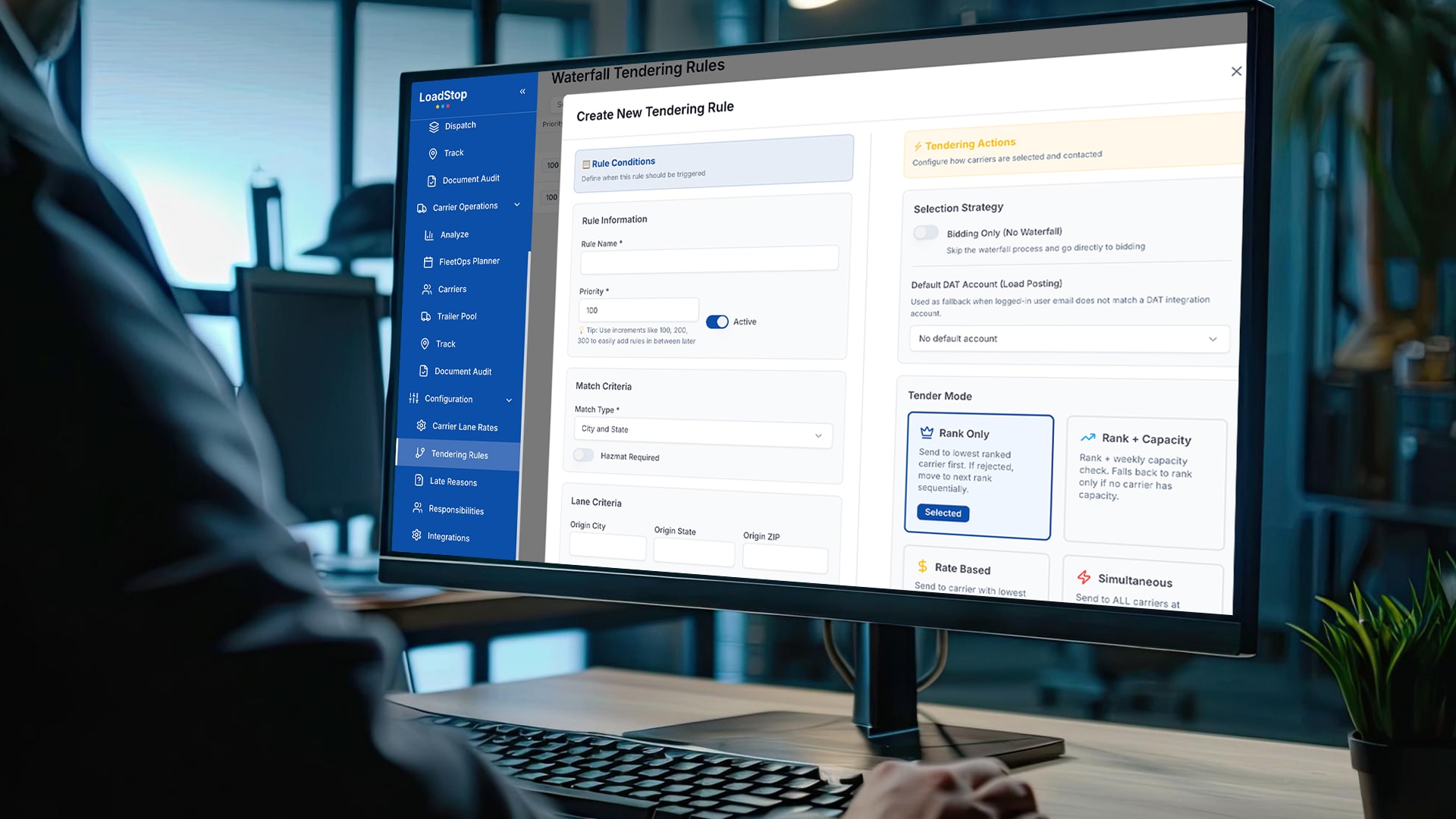
A load does not become expensive all at once. It becomes expensive due to small delays.
A carrier does not answer. A backup carrier needs ten more minutes. A rep waits for a callback. A dispatcher checks an old spreadsheet. Someone posts the load wider than planned. The team receives a low quote from a carrier with a weak service history and a higher quote from a carrier that is familiar with the lane. The customer wants an update. The clock keeps moving.
Speed matters, but speed without rate discipline is just a faster way to lose margin.
That is why waterfall tendering is more than an operational tactic. Done well, it is a rate-control system. It helps freight brokers, fleets, shippers, and carrier procurement teams give preferred providers the first opportunity, move quickly through backup capacity, escalate to spot only when needed, and make award decisions with cleaner data.
LoadStop Waterfall Tendering turns those rules into execution: AI-powered carrier outreach, competitive bid collection, performance-based ranking, rate and margin logic, and human escalation at defined thresholds.
Why Rate Control Depends on Tender Sequencing
Freight coverage is not only a speed problem. It is a sequencing problem.
When a team immediately blasts a load to the broadest possible market, it may create activity, but activity is not the same as control. A broad send can generate noise, duplicate conversations, inflated expectations, and inconsistent rate decisions.
Waterfall tendering protects rate discipline by giving the right carriers the right opportunity in the right order.
In other words, a waterfall is only as strong as the execution behind it. If your team waits too long between rejections, follows up manually, or cannot compare bids quickly, the waterfall can still leak time and margin.
Waterfall tendering is not about delaying coverage. It is about controlling the order of outreach, so preferred carriers get the first opportunity, backup carriers are engaged quickly, and spot escalation happens with guardrails instead of panic.
The Science Behind Routing Logic or Waterfall Tendering
Waterfall tendering is a structured freight tendering method or routing logic where a load is offered to carriers in a defined sequence, usually starting with the best-fit preferred carrier and then moving to backup and fallback carriers if the load is rejected or no response arrives within a set time window.
In freight brokerage, shipper transportation, and fleet dispatch operations, this sequence is often called a carrier waterfall, routing guide, preferred carrier tendering process, or tiered carrier bidding workflow.
A simple waterfall tender might look like this:
The goal is not simply to find the cheapest carrier. The goal is to find the best available carrier based on rate, service, equipment match, lane history, availability, risk, and margin logic.
MIT's Center for Transportation and Logistics research on routing guide performance found that in tight markets, loads could move beyond multiple backup carriers without being accepted and then end up on the spot market at a higher cost after more time had passed.
That distinction matters. A cheaper bid may not be the best decision if the carrier has weak on-time performance, poor communication history, limited equipment fit, or a pattern of service failures on similar lanes.
How Does LoadStop Waterfall Tendering Help Your Team?
In simple words, LoadStop Waterfall Tendering helps teams move from manual calls and scattered emails to structured, auditable, ranked carrier decisions.
Instead of requiring a broker, dispatcher, or procurement user to manually contact each carrier, LoadStop supports automated outreach and bid collection while keeping the team in control through approval rules, margin thresholds, and escalation logic.
LoadStop's Five-Stage Waterfall Coverage Process
Infographic
LoadStop's Five-Stage Waterfall Coverage Process
Waterfall Coverage Request
Each load is matched against the preferred carrier waterfall, load board publishers, and internal capacity lists before outreach begins. That gives the team a cleaner starting point than "who should I call first?"
AI Carrier Outreach
LoadStop's AI can contact the carrier network around the clock. This helps reduce idle time when the coverage desk is busy, after hours, or waiting on callbacks.
Bid Collection and Normalization
Carrier responses can come from voice, email, portals, and boards. LoadStop brings those bids into one place, normalizes the information, and makes them easier to compare.
Performance-Based Ranking
Bids are not ranked by price alone. LoadStop can surface carrier availability, bid amount, market rate, carrier performance, risk factors, equipment match, and rate/margin logic.
Smart Coverage Execution
The team can award with more confidence because the best available option is visible before the lane is lost to slower outreach. The goal is not uncontrolled automation. The goal is faster execution with humans still guiding exceptions and approvals.
AI-powered carrier outreach, competitive bid collection, performance-based ranking, and human escalation at defined thresholds.
How Waterfall Tendering Logic Works Inside LoadStop
Waterfall tendering is easy to understand when you think of it as a controlled load coverage workflow. The freight does not immediately go to every carrier in the market. It moves through a sequence based on business rules.
The Load Enters the TMS
The workflow starts when a load is created or imported into the TMS. The system captures the core shipment details:
- Origin and destination
- Pickup and delivery windows
- Equipment type
- Commodity and service requirements
- Customer rate, target buy rate, or budget
- Lane history
- Contracted or preferred carrier rules
In a manual workflow, a dispatcher or broker rep reviews the load and starts calling. In a waterfall tendering workflow, the load is matched against carrier rules before outreach begins.
The System Identifies the Preferred Carrier Waterfall
The platform checks the lane against the preferred carrier network, internal capacity lists, and other configured coverage options.
Waterfall tendering works best when the rules are clear before the load needs coverage. In LoadStop, that logic is managed through Tendering Rules. Each rule defines two major parts of the workflow:
- Rule Conditions: when the rule should be triggered
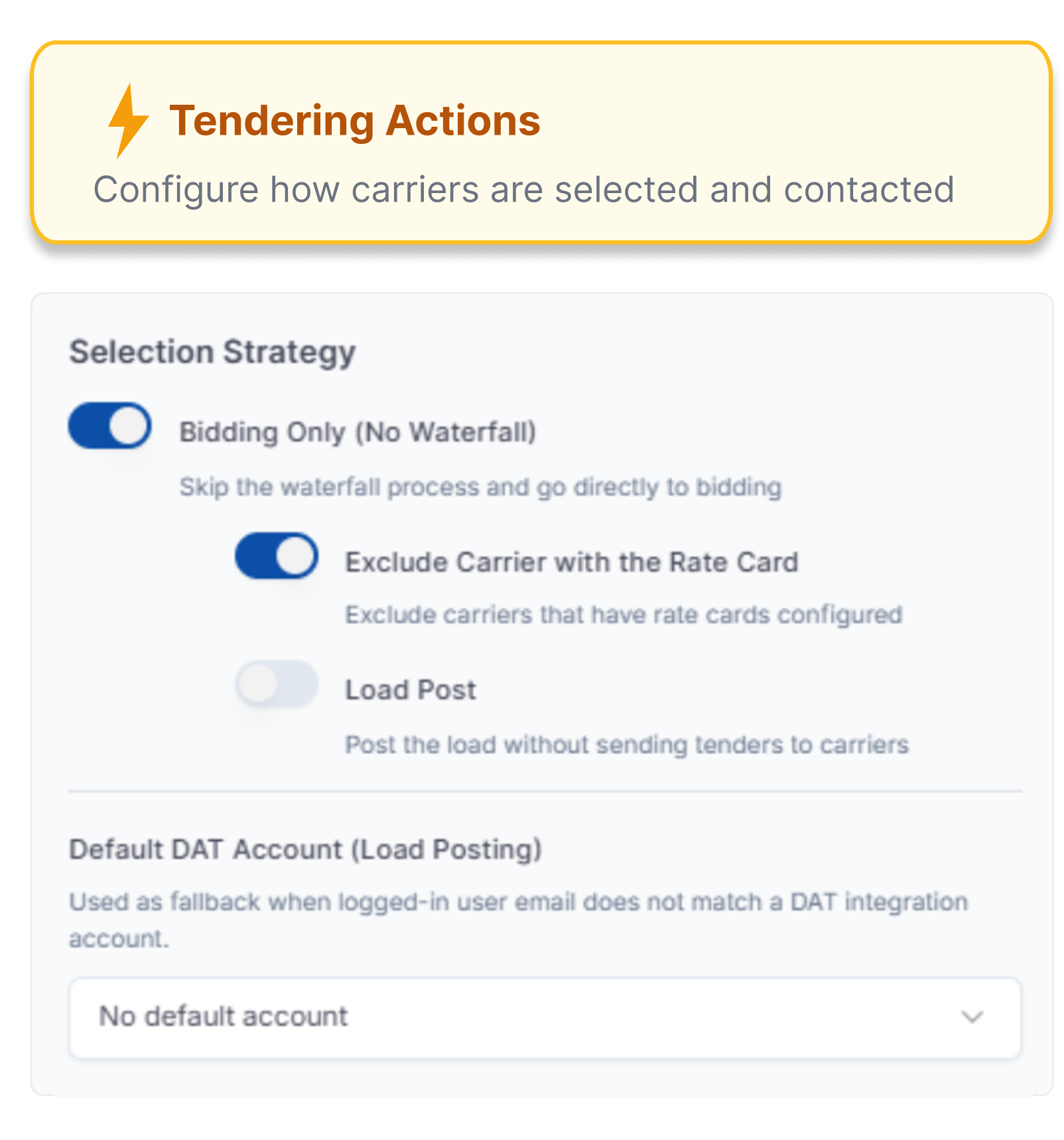
- Tendering Actions: how carriers should be selected and contacted
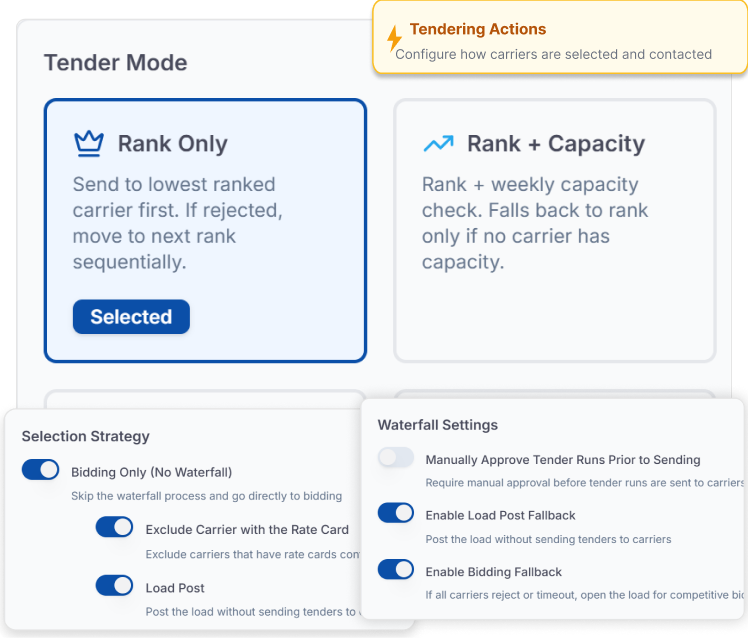
Tendering Actions: configure how carriers are selected and contacted.
This matters because a waterfall tendering process should not depend on memory, sticky notes, or whoever happens to be working the desk. The workflow should be configured around the lane, equipment, carrier ranking, rate logic, fallback rules, and approval thresholds.
Carrier A Gets the First Opportunity Based on Tendering Rules
The first tender typically goes to the primary carrier because that carrier has earned first position through contract commitments, historical performance, rate agreement, lane fit, or strategic relationship value.
Preferred carriers should get the first opportunity when they match:
- The lane
- The equipment
- The pickup and delivery requirements
- The target rate
- The service expectations
- The risk threshold
Infographic
Tender Rules: How Each Mode Works
| Tender Rule | How It Works | Best Use Case |
|---|---|---|
Rank Only |
Sends to the lowest-ranked carrier first. If rejected, moves to the next rank sequentially. | Primary lanes where carrier ranking and order matter most. |
Rank + Capacity |
Checks weekly capacity first, then falls back to rank-only logic if no carrier has capacity. | Contract lanes where carrier commitment and capacity matter. |
Rate Based |
Sends to the carrier with the lowest contracted rate first, then proceeds sequentially by price. | Cost-sensitive lanes where rate discipline is the priority. |
Simultaneous |
Sends to all carriers at once. First to accept wins. | Urgent freight when speed matters more than sequential outreach. |
A waterfall is only as strong as the rules behind it. Configure each rule around the lane, equipment, carrier ranking, and rate logic.
Rejection or No Response Triggers the Next Carrier
If Carrier A rejects the tender or does not respond within the configured time window, the system moves to the next carrier in the sequence. This is the core of waterfall tendering: tender rejection does not create operational limbo.
Instead of a broker rep manually remembering to follow up, the workflow can automatically send the next tender.
Backup and Fallback Carriers Receive the Load
The load continues through the waterfall until a qualified carrier accepts, the team chooses a bid, or escalation rules are triggered.
Backup carriers are not random. They are usually selected based on lane history, carrier scorecard, price discipline, capacity availability, service performance, and customer requirements.
If the preferred carrier waterfall cannot cover the load, the workflow can escalate to:
- Wider RFQ
- Spot market network
- Load board
- Simultaneous tendering for urgent freight
- Human escalation for exception handling
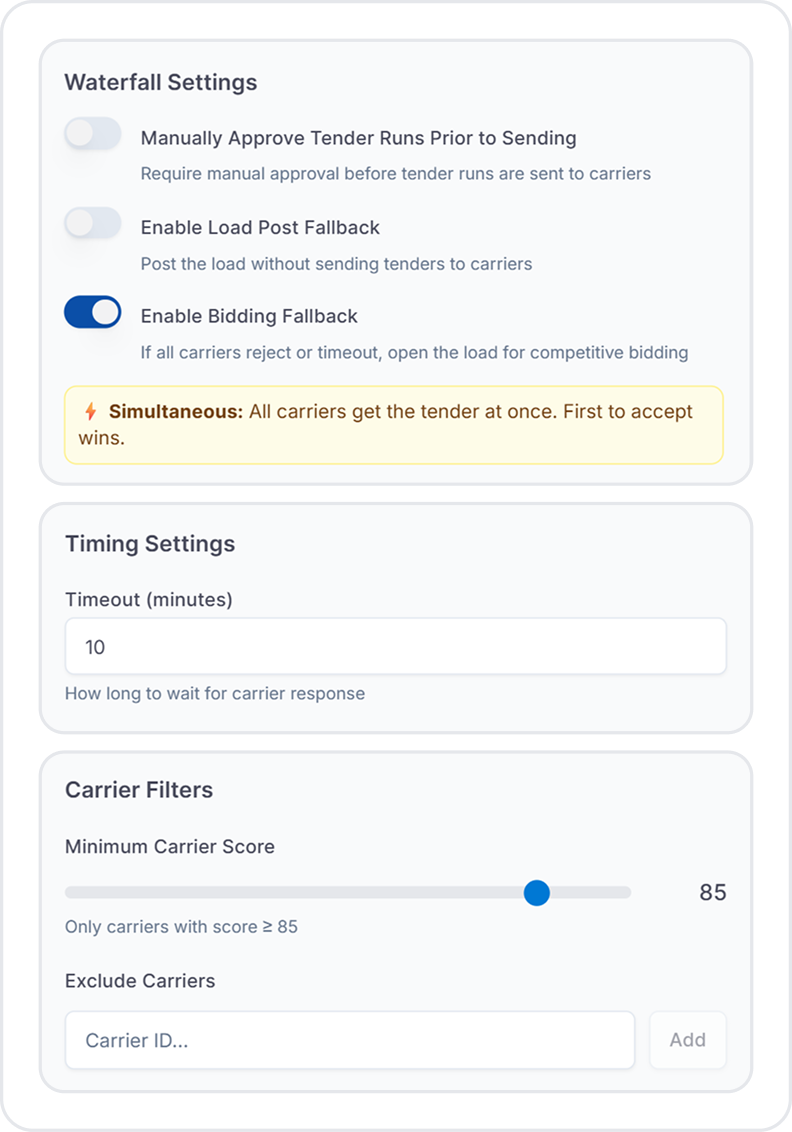
These settings include:
- Manually Approve Tender Runs Before Sending: requires manual approval before tender runs are sent to carriers.
- Enable Load Post Fallback: allows the load to be posted when configured fallback logic applies.
- Enable Bidding Fallback: opens the load for competitive bidding if carriers reject or time out.
Benefits for Brokers, Fleets, Shippers, and Procurement Teams
For Freight Brokers
Freight brokers need fast coverage, but they also need margin control. LoadStop Waterfall Tendering helps brokers automate carrier outreach, collect more bids, compare options, and protect the quote-to-cover workflow from manual delays. Instead of waiting on one callback at a time, teams can see carrier bids, scorecards, market context, and risk factors in one place.
For Fleets and Dispatch Teams
Fleet managers, owner-operators, and dispatch teams can use tender automation to reduce manual coordination and respond faster to available freight. When carriers are matched to the right lanes and equipment requirements, dispatchers spend less time sorting through poor-fit opportunities.
For Shippers
Shippers can use LoadStop TMS Copilot for Shippers as a contract and spot tendering execution layer. The shipper deck positions LoadStop as a way to maximize contract coverage, lower spot premiums, and create more predictable freight expense through contract-first execution, waterfall rules, RFQ templates, vetted service provider networks, and structured data back into ERP systems. That means a shipper can start with contracted providers, then escalate to spot market RFQs when needed. LoadStop materials also reference wide-range RFQs to 300+ service providers within the spot market network when the contracted waterfall cannot cover.
For Carrier Procurement Teams
Procurement teams need more than a final invoice. They need to understand target rate, buy rate, carrier acceptance, tender rejection, lane history, service failures, and budget variance. LoadStop supports that by capturing structured tender data, award decisions, milestones, and SLA events. The shipper deck highlights proactive SLA monitoring across total SLA events, on-time performance, preventable versus non-preventable failures, contract-specific milestones, and real-time compliance scoring.
How to Know If Your Team Needs Waterfall Tendering
Waterfall tendering software is especially useful when load coverage has outgrown manual coordination.
Your Mini Checklist
Your team may be ready for automated tendering if:
You call or email carriers one by one for most loads.
Your best carrier options often respond after the load is already covered.
You post to load boards before exhausting preferred carrier options.
You struggle to compare carrier bids across voice, email, portals, and boards.
You do not consistently track tender rejection and carrier response time.
Your team cannot easily see lane history during coverage.
Your rate decisions are based on memory instead of market and scorecard data.
Your margin review happens after the load, not during award.
Your procurement team lacks clean tender outcome data.
Your team needs human approval thresholds for high-risk or low-margin awards.
If several of these sound familiar, the issue is not only carrier availability. It is workflow design.
Conclusion: Every Rejection Needs an Immediate, Structured Next Step
Manual carrier outreach looks manageable from the outside. A few calls, a few emails, a few texts, a few portal checks.
Inside the coverage desk, it is different. Every delay creates a decision gap:
Should the team wait for the preferred carrier or move on?
Is the backup carrier still available?
Is the current bid above market, or is the market moving?
Is a cheaper carrier actually safe to award?
Is spot escalation necessary yet?
Will the customer rate still protect the margin?
The problem is not simply that carriers reject loads. The problem is that every rejection needs an immediate, structured next step.
Waterfall Your Carrier Outreach With LoadStop
Want preferred carriers first and spot market last? See how automated tendering can support faster coverage with stronger rate discipline.
Schedule a Demo