

On May 15, 2026, the Supreme Court decided Montgomery v. Caribe Transport II, LLC. The ruling was unanimous. Federal law, the justices said, does not shield brokers from state negligent hiring lawsuits.
The case traced back to a 2017 accident. A broker had booked a carrier that already carried a "conditional" federal safety rating. Justice Kavanaugh's concurrence set the bar in his opinion: brokers who act reasonably and select reputable carriers should be able to defend themselves. However, "reasonably" now needs a paper trail, not a good feeling about the guy on the phone.
That's a problem if your onboarding process lives in an email inbox.
The Problem With Onboarding by Email
Here's how it still works at a lot of brokerages.
A dispatcher finds a carrier on DAT or Truckstop.
Someone emails a packet: a broker-carrier agreement, a W-9, a request for a certificate of insurance.
Two days pass.
The carrier replies from a different email address than the one on file, with half the documents attached.
Somebody pulls up FMCSA's SAFER system to check the USDOT number by hand.
Somebody else calls the insurance producer, because carriers have, on occasion, forwarded a COI that expired back in March.
None of it is hard. It's just slow, and slow gets expensive fast when a load is sitting uncovered. A broker running this by hand can burn three full days getting one carrier from "interested" to "active." Multiply that across every new carrier a growing brokerage needs each month, and the bottleneck isn't sales. It's paperwork, hiding behind a spreadsheet nobody enjoys updating.
Additionally, there's fraud to worry about. A chameleon carrier re-registers under a new USDOT number or a renamed LLC to shed a bad safety record, while running the same trucks and the same dispatchers as before. Double brokering exploits the same blind spot: a broker who checks once and trusts forever. Highway's Q1 2026 Freight Fraud Index found that roughly half of that quarter's theft incidents involved carriers holding legitimate MC numbers and previously clean operating histories. Therefore, a background check run once at signup isn't a safeguard. It's a false sense of security with a nice PDF attached.
This is why freight broker TMS platforms are absorbing carrier onboarding instead of sitting beside it as a separate tool nobody quite trusts.
What Carrier Onboarding Actually Means in Freight Brokerage
Freight broker carrier onboarding is the process a broker runs before, and immediately after, handing a carrier a load. It means verifying who the carrier is, confirming they're legally authorized to haul freight, and checking their insurance and safety history. It also means collecting the paperwork that turns "a truck we found on a load board" into "a vetted partner in our network."
Done properly, it produces two things: a carrier that's actually qualified, and a record showing why the broker believed that at the time. Most brokers already know this. What's changed is how much of it can now run without a human opening a single email.
Two Gates: Pre-Award Qualification and Post-Award Execution
Brokers who've automated this well describe it the same way. A carrier approval workflow, whatever you call it, isn't one step. It's two gates. A TMS is what enforces both without a person standing at either one.
Gate one is pre-award qualification. This happens before a carrier ever sees a load, or before their bid counts for anything. The system checks FMCSA authority, insurance status, and safety score automatically, the moment a carrier enters the network or responds to a bid request. A carrier that's out of service, uninsured, or unauthorized never makes it into the bidding pool.
Gate two is post-award execution. Once a carrier wins the load, the TMS moves fast. It generates a rate confirmation, routes the broker-carrier agreement and W-9 for e-signature, and sets up ACH details for payment, without anyone re-keying information already collected during pre-award qualification.
This two-gate structure is the real answer to "how do you automate carrier onboarding with a TMS." It's not one big automation. It's qualification and execution, running as separate, connected steps.
The TMS Carrier Onboarding Journey
Six automated checkpoints, from first bid to ongoing compliance
 2
2
Insurance &
Fraud Screening
 4
4
Instant Rate
Confirmation
 6
6
Continuous Compliance
Monitoring
 1
1
FMCSA Authority
Check
 3
3
Digital Carrier
Packet
 5
5
Automatic
Payment Setup

One platform to dispatch, cover, invoice, and stay compliant.
loadstop.comHow to Verify Carrier Compliance Before You Award a Load
FMCSA authority verification is the floor of carrier qualification automation, not the finish line. A TMS with carrier vetting automation built in runs a SAFER lookup against the USDOT number the moment a carrier is entered, pulling operating authority status, safety score, and out-of-service status straight from FMCSA's Licensing & Insurance database. If a carrier's authority is revoked, or their safety rating slipped since the last check, the system flags it before a dispatcher ever sees the bid.
Carrier insurance verification works the same way, minus the phone call. Instead of ringing the insurance producer, the TMS checks certificate of insurance data directly, covering auto liability insurance and cargo insurance limits, and keeps checking on a schedule rather than once at signup. This matters more than it sounds like it should. A carrier that passed every check in January isn't guaranteed to still be clean in July. Compliance checks that only run at onboarding miss exactly the failures that show up later.
Fraud prevention is the part most onboarding checklists skip, and it's the part costing brokers the most right now. Double brokering risk and chameleon carrier schemes both exploit the same gap: a broker who vets once and trusts forever.
Picture the tells a chameleon carrier leaves behind:
Authority registered last month. Experience claimed: fifteen years.
An address or phone number shared with another carrier already in the system.
An insurance carrier that's changed twice in six months.
None of these facts alone proves fraud. Together, however, they're worth a human look before a load gets tendered. Carrier identity verification and document verification, run consistently at intake, catch most of this before it becomes a claim, or worse, a courtroom exhibit.
LoadStop's Carrier Onboarding and Waterfall Tendering
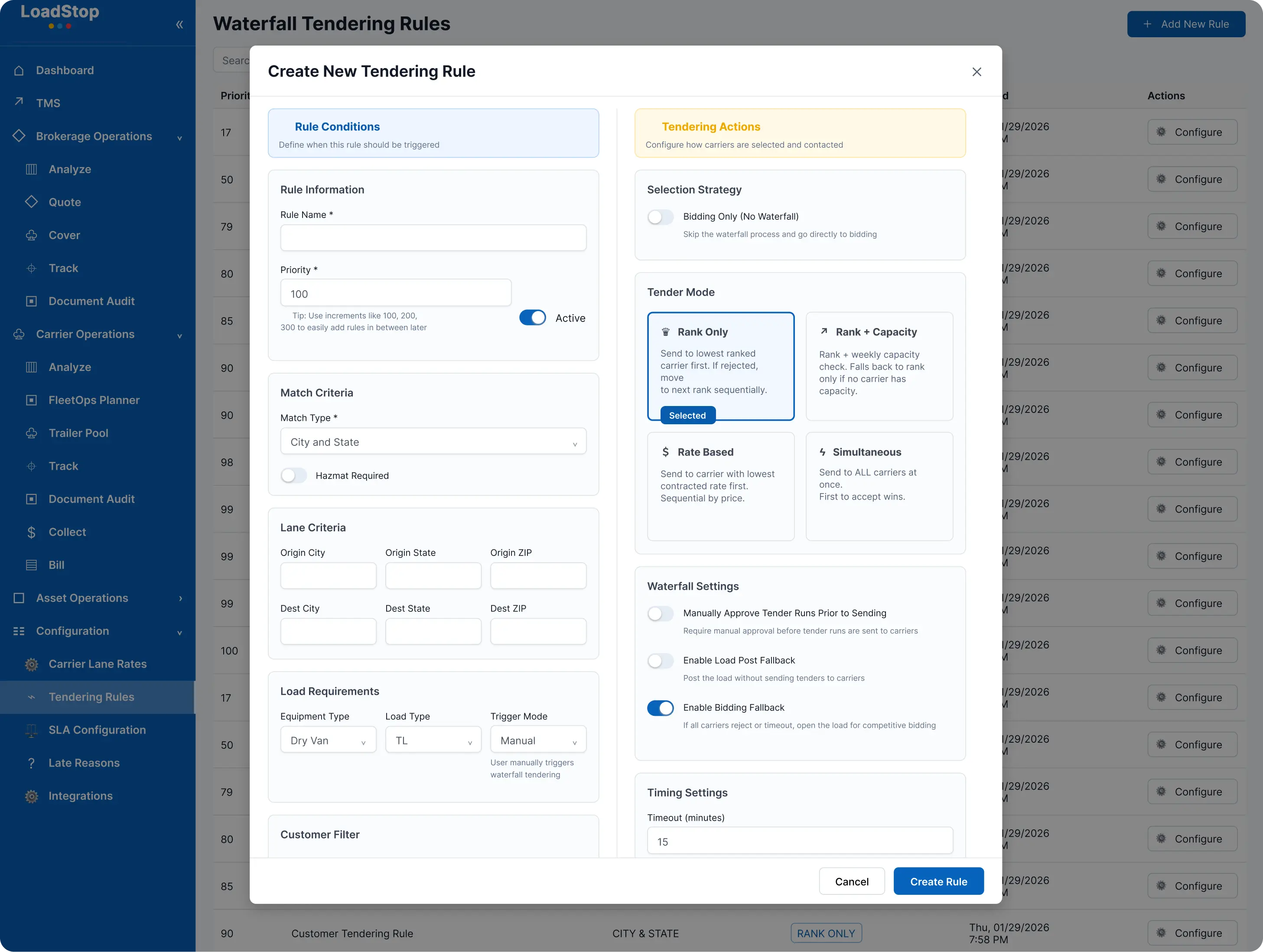
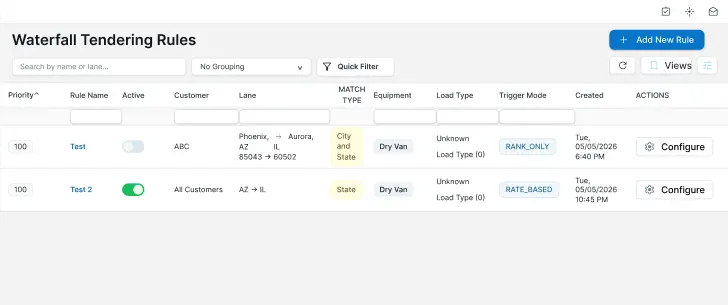
LoadStop runs FMCSA authority, insurance, and safety score checks automatically, the moment a carrier enters the network, instead of a dispatcher doing it by hand with twelve browser tabs open. Waterfall Tendering then applies those same compliance checks to the tendering sequence itself. A carrier who fails doesn't just get flagged. They get skipped, and fallback logic moves the load straight to the next qualified carrier in line.
Turning an Approved Carrier Into an Active One
Once a carrier clears pre-award qualification, post-award execution is where carrier setup automation earns its keep. This is carrier packet automation in the literal sense. Instead of emailing a PDF and waiting, the TMS assembles a digital packet with the broker-carrier agreement, the W-9, and any factoring paperwork like a Notice of Assignment, then routes it for e-signature. Carrier document collection happens inside the portal the carrier already used to submit their bid, not a separate inbox that gets missed.
Automated rate confirmation is the piece that actually gets freight moving. The moment a carrier is awarded the load, the rate con generates and sends itself, pre-filled with the agreed rate, pickup and delivery details, and reference numbers, ready for signature. No back-and-forth over which version is current. Carrier payment setup, the ACH form and any factoring company details, gets collected once and reused for every future load, so it's not re-litigated every time the same carrier hauls again.
Instant Rate Confirmation and Automatic Payment Setup
LoadStop's Instant Rate Confirmation generates and sends the rate con the second a carrier wins the load, no dispatcher required. Pair that with the Carrier Onboarding module's automatic W-9 and ACH capture, and a carrier can go from "awarded the load" to "ready to haul it" without a single new email.
The Carrier Setup Packet Checklist
Every carrier packet checklist looks roughly the same, whether it's built for a manual process or an automated one. What changes is who does the chasing. Here's what a complete carrier setup packet includes:
The Carrier Setup Packet Checklist
Ten items, whether a person chases them or a TMS does

Carrier Profile /
Fact Sheet
W-9
Certificate of
Insurance

Operating Authority
Documentation
Broker-Carrier
Agreement

Safety Score
Snapshot

Notice of
Assignment
ACH Form
Out-of-Service
Status Check

Ongoing Status
Re-Checks
One platform to dispatch, cover, invoice, and stay compliant.
loadstop.comTen items, roughly. None of them are optional if a broker wants a defensible file. All of them can move through a digital carrier onboarding portal without a single attachment vanishing into someone's inbox.
Compliance Doesn't Stop at Go-Live
This is the part a lot of onboarding checklists leave out entirely. A carrier that passed every check on day one can lose its authority, let insurance lapse, or pick up a bad safety score six months later. A broker who never checks again won't know until something goes wrong, usually at the worst possible time.
Carrier compliance automation, the same engine that ran the pre-award checks, keeps running on a schedule. Call it carrier compliance monitoring if you'd rather. Either way, it's the same idea: insurance expiration alerts, authority status changes, and safety score movement all flow into the same system that ran the original vetting, not a separate spreadsheet somebody updates when they remember to.
Continuous Compliance Monitoring in LoadStop
LoadStop maintains continuous insurance monitoring after onboarding instead of a one-time check at signup. It's why one broker running LoadStop, Super Express, reports zero lapsed-insurance events since switching over. Not a slogan. An actual number.
This is also, not incidentally, exactly the kind of ongoing record that matters under the Montgomery standard.
"We checked once, eighteen months ago" is a much weaker defense than "we checked continuously, and this carrier's status never changed."
Why Onboarding Speed Also Means Better Load Coverage
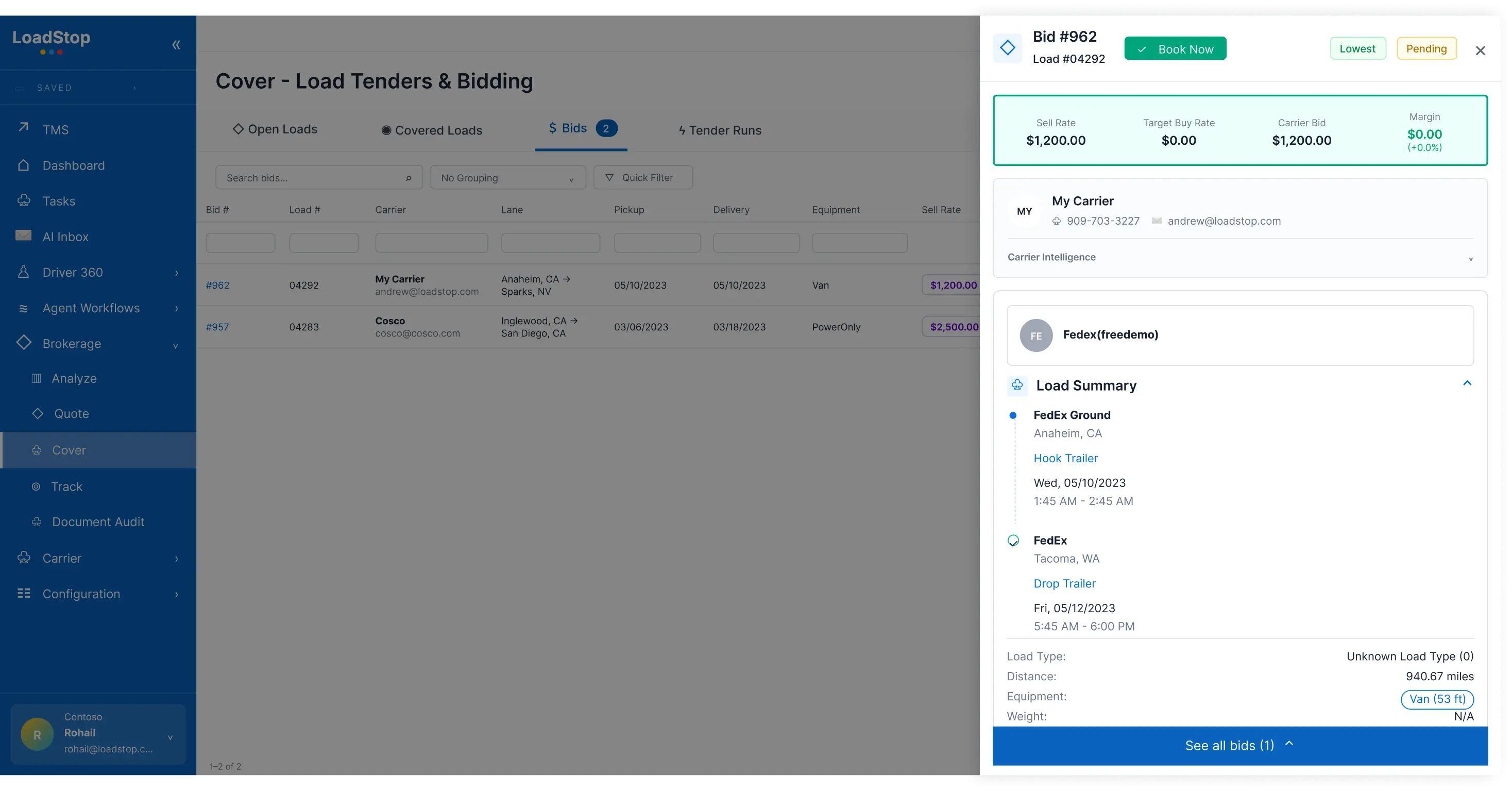
Onboarding automation doesn't stop paying off once a carrier is approved. Every load a carrier hauls generates a carrier performance score, built from on-time pickup and delivery, claims history, and communication. That score then feeds directly into bid ranking on the next load: a carrier with a strong track record on the Chicago-to-Dallas run should outrank a stranger with a lower price and no history on that lane.
Bid Ranking by Performance
LoadStop's Bid Ranking by Performance does exactly that automatically, ranking every bid by price, performance score, and lane reliability together. No dispatcher has to eyeball a spreadsheet and make the call every morning.
This is carrier network management in practice. Onboarding isn't a one-time gate a carrier passes through once. It's the start of a record that keeps building every time that carrier hauls a load. Therefore, it's what turns a list of vetted carriers into an actual network a broker can lean on when capacity gets tight.
Automate carrier onboarding with LoadStop
FMCSA verification, insurance monitoring, instant rate confirmations, and continuous compliance, all in one connected TMS.
Schedule Demo