
Imagine running a regional dry van fleet with 40 trailers parked across six different customer yards, where nobody on your team can verify for sure which units are empty, which are loaded, and which have sat untouched for three days.
That was the exact challenge facing one of our regional carrier partners. Every single morning, their dispatchers spent an hour calling drivers and yard staff to find equipment. Customers frequently called to ask about trailer locations before dispatchers could provide an answer, and unexpected detention bills accumulated for trailers that had simply been forgotten.
As you can expect, this is what happens when you operate without trailer pool visibility. Simply put, trailer pool visibility gives you a real-time window into where every trailer in your pool is located, whether it holds cargo or sits empty, and how long it has remained idle. Let us walk through what this actually means, why growing fleets run into obstacles without it, and how LoadStop resolves these daily operational challenges.
What Is Trailer Pool Visibility?
At its core, trailer pool visibility means having real-time knowledge of every single trailer tied to your operation: its exact spot, its current status, and its dwell time. A trailer pool is basically your inventory of trailers stationed at customer yards, terminals, or drop yards so your drivers can drop off a unit and hook onto a new one instead of waiting around for a live load or unload.
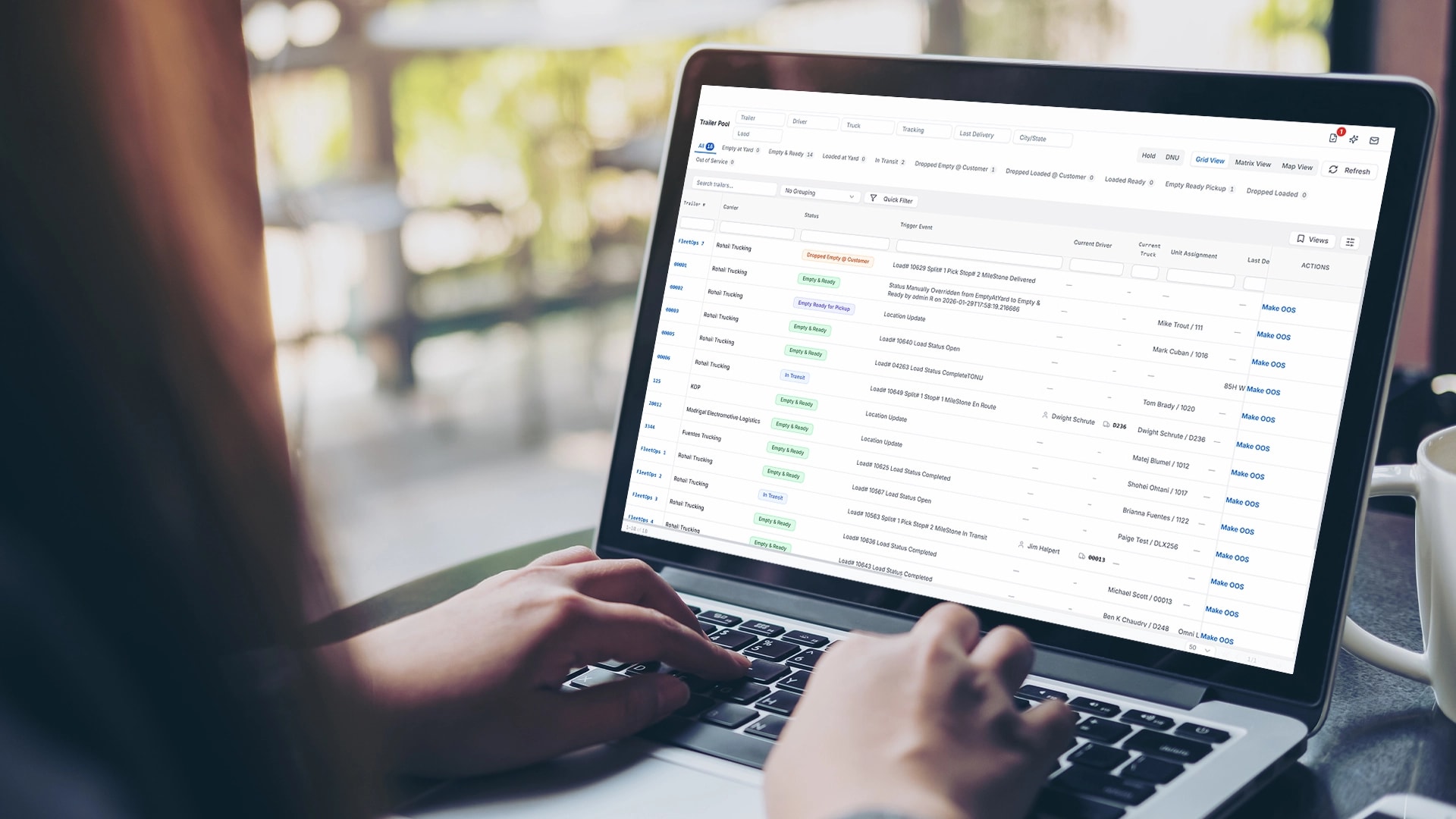
As industry discussions around modern transportation management systems highlight, managing these assets involves tracking specific statuses like empty and ready, empty at the yard, loaded at the yard, in transit, or dropped empty at customer locations. LoadStop brings all of this together by combining GPS trailer tracking, geofencing around customer facilities, and ELD data so your dispatch team gets a live, accurate picture of every yard efficiently.
Furthermore, LoadStop enables users to pre-plan available trailers directly to incoming loads, instantly tying equipment to dispatches and managing out-of-service or do-not-use statuses when equipment requires maintenance.
Those statuses are not just labels. They are the difference between a trailer you can use right now and one you are still hunting for. Here is what each one actually means.
The 6 Trailer Statuses Every Dispatcher Should Track
Location tells you where a trailer is. Status tells you whether you can use it.
| Empty & Ready | Empty at a customer location, ready for pickup now. |
| Empty at Yard | Empty at your own terminal, deployable anywhere. |
| Loaded at Yard | Loaded, waiting for a second driver to relay it. Common in split loads. |
| In Transit | Attached to a truck and moving. |
| Dropped Empty at Customer | Staged ahead of tomorrow's load, waiting to be filled. |
| Dropped Loaded at Customer | Waiting on the customer to unload. Most likely to turn into detention. |
Six statuses, one dashboard. A dispatcher searching any yard should see all six at a glance, not chase them down one call at a time.
Knowing the six statuses is one thing. Actually tracking them without a system is where most fleets fall apart.
Trailer Pool Visibility vs Manual Yard Checks
Before dedicated real-time trailer visibility software became available, most fleets relied on traditional manual yard checks. Staff members would physically walk the yard or call multiple drivers just to see what was parked where.
Manual checks are slow, they lose accuracy within a few hours, and frankly, they do not work once your fleet starts growing past a small number of trailers.
In contrast, automated visibility via LoadStop pulls all active and inactive trailers into a main AI-First TMS dashboard, sorting them instantly by status, location, and assigned loads.
Why Growing Fleets Struggle With Trailer Pools
Trailer pool management is designed to prevent dwell time and keep drop-and-hook operations running smoothly. However, if you leave a pool unmanaged, it tends to create a brand new set of problems:
Your trailer-to-tractor ratio increases without your team noticing. Without clear visibility, fleets often purchase brand new trailers just to compensate for units they cannot locate, rather than optimizing the pool they already manage.
Determining empty trailer availability turns into an estimation challenge. Your dispatchers cannot confidently promise an empty trailer to a customer if nobody actually knows what is sitting on the lot.
Unmonitored dwell time quietly turns into costly detention. If a trailer sits at a customer yard for three extra days, it is very easy to overlook unless you have automated tracking alerts keeping score.
Security vulnerabilities emerge. Unmonitored trailers left at third-party locations can sometimes be utilized for unauthorized loads, which is why having risk filtration alerts is so crucial for catching tracking discrepancies early.
The math behind this problem is bigger than any one fleet's yard. Here is what an unmanaged trailer pool actually costs across the industry.
What an Unmanaged Trailer Pool Actually Costs
Detention doesn't start with a customer holding a trailer too long. It starts with nobody knowing where the trailer was.
$1.1–$1.3B
Estimated annual detention cost to the trucking industry
Source: OOIDA
~80%
Of carriers lose a load opportunity a month to detention
Source: OOIDA
2:1 ratio
The typical trailer-to-truck ratio. Most trailers are detached from a tractor at any given time, tracked or not.
Dispatch spends the first hour of the day just finding out what's empty and where.
Detention shows up as a surprise on the invoice, not while it's still happening.
New trailers get bought to cover for ones nobody can locate.
Customers report a trailer's status before dispatch does.
A pool that runs fine at 10 trailers usually breaks by 40. Not because the fleet grew wrong, just because nobody tracked it as it scaled.
None of that has to be permanent. Here's what changed for one fleet once it fixed the visibility gap.
How One Growing Fleet Fixed Its Trailer Blind Spot
Returning to that regional dry van carrier we discussed earlier, their 40-trailer pool was losing money through wasted phone time, unexpected detention fees, and frustrated customers.
Once they onboarded LoadStop AI-First TMS and used its Trailer Pool module, three things changed almost overnight:
Those tedious morning yard calls completely disappeared. Dispatchers could view trailer statuses the second they opened their dashboards instead of spending the first hour chasing people down on the phone.
Detention costs dropped sharply. Trailers sitting past their free time triggered automated alerts instead of showing up as a nasty surprise on the next invoice.
Customer communication became totally proactive. Instead of clients calling to ask where their equipment was, they received automatic updates before they even had to ask.
How Trailer Pool Visibility Improves Customer Service
At the end of the day, great customer service in trucking usually boils down to answering one question early and accurately: where is my freight, and when is it getting here?
Predictive ETAs get a lot sharper when you know the exact location of a loaded trailer, rather than estimating based on where the tractor happens to be.
Exception management flags minor issues, such as a trailer stuck at a yard past its pickup time or flagged with a location risk, long before they turn into missed deliveries.
Scorecard maintenance gets easier because catching problems early means fewer service failures hitting your customer scorecards.
If you want to take a deeper dive into how real-time tracking changes client relationships, you can check out Real-Time Load Tracking and Visibility for Shippers.
Utilizing advanced tools like LoadStop's AI Toolkit helps fleet managers catch extended dwell times before they throw a wrench into your daily operations.
TMS Capabilities for Power-Only Brokers and Fleets
Visibility platforms are not just for traditional asset-based fleets. If you operate as a broker running power-only models, meaning external carriers bring their own tractors to hook up to your loaded brokerage trailers, having a centralized trailer pool setup in LoadStop is a major advantage.
Most standard broker transportation management systems do not come with built-in trailer pool modules. By integrating asset-level tracking, LoadStop allows brokers to oversee power-only operations, keep an eye on dwell times, and run efficient yard management workflows.
Essential TMS Features to Look For:
Unified inventory that pulls active and inactive trailer profiles into one clean interface.
Pre-planning tools that let you assign available trailers to upcoming loads while easily managing out-of-service statuses.
Electronic logging device and reefer monitoring that integrates real-time stats like temperature and fuel levels from top tracking providers like Samsara, Motive, Orbcom, and Geotab.
Automated risk flags that alert you to unexpected location changes or potential equipment misuse.
To make sure your data flows smoothly without forcing your team to re-enter information across different platforms, take a look at our guide on how to Eliminate Double Data Entry Using TMS Integrations. You can also explore how LoadStop's Load Tracking feature gives you a complete, unified view of your entire equipment ecosystem.
See Trailer Pool Visibility in Action
See how LoadStop brings real-time trailer tracking, geofencing, automated dwell alerts, and dispatch workflows into one connected TMS.
Schedule Demo